



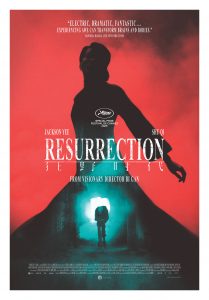
“Resurrection” (“Kuangye shidai”)
(China/France/USA)
Metacritic (7/10), Letterboxd (3.5/5), Imdb.com (7/10), Imdb.com critics review
#BrentMarchant #Resurrection #BiGan #China #dreams #immortality #Deliriant #cinemahistory #filmartistry #Buddhism
Is artistry by itself enough to make a film worth recommending? That’s a question many cinephiles have wrestled with throughout the history of this artform. But can a picture’s visuals alone make it a truly worthwhile experience? Such is the debate dogging the latest offering from visionary writer-director Bi Gan, an ambitious, undeniable feast for the senses despite its tendency toward inscrutability. In all truthfulness, it’s difficult to say what this film is actually about given that its narrative has widely (and, frankly, quite accurately) been described as being “opaque.” The various elements that make up this picture can honestly be interpreted in myriad ways, and they don’t always mesh together well, even if, individually, they can be quite captivating (though not necessarily in equal measure). Some have interpreted the film as a meditation on the six senses recognized in Buddhist thought. Others have contended that its various segments are metaphors that correspond to different periods in 20th Century Chinese history. And others still have said that it’s a survey on the art and history of cinema and how it can be employed to reflect and impact human consciousness and sensibilities. Some have even maintained that it’s a treatise on the very nature of life and death itself. From my viewpoint, it’s a loosely drawn combination of all of these interpretations (albeit not especially cohesively). I found it frequently captivating, sometimes exasperating and occasionally confounding, but the vivid imagery, diverse filming styles, wide-ranging period settings, ethereal score, differing thematic motifs and core sci-fi storyline are generally mesmerizing, making this a truly unique watch. But I can’t say with absolute certainty that I know exactly what the filmmaker was going for here. In fact, I’m not entirely sure he was clear about this himself, particularly given the sheer volume of material that’s been included in this picture. If this carefully qualified assessment makes me sound like something of an apologist, then I’d say I’m guilty as charged. But, then, I must also note that a number of the film’s core narrative elements go largely unexplained, leaving viewers to wonder about the logic and reasoning behind them. In essence, the film is set in a future time frame when most of humanity has lost its capacity for dreaming, swapping this capability for immortality. However, certain individuals, referred to as “Deliriants,” have held on to their somnambular abilities, leaving “the Others” to wonder how and why they have retained them – and prompting the dreamers to feel persecuted, looked upon as threats, and forcing them into hiding, mostly in the realm of cinema. One of the immortals, The Great Other (Shu Qi), a researcher of sorts who wants to know more about the Deliriants, proceeds to track down one of them, the Monster (Jackson Yee), to determine how he has taken up residence in the world of celluloid through the years as a means to cover his shape-shifting capabilities and thereby to remain largely undetected. When she tracks down the Monster while he’s in a weakening state, she implants a film projector in his chest cavity to capture the visions that make up his dreams in order to try and better understand him and his peers. From there, the picture then launches into depictions of four of the Deliriant’s dream experiences, showing him in his various changeling iterations. It’s an intriguing premise, to be sure, but many fundamental questions are left unanswered: How and why did this change come about? Why was losing the capacity for dreaming the key to longevity? What relation, if any, is there among the particular dream experiences of this Deliriant (and is that true for others of his kind)? And why is The Great Other so preoccupied with (and perhaps threatened by) them? Given the lack of explanation in these areas, I guess we’ll never know the answers to any of these questions, which is where the bewilderment about the narrative’s opaqueness comes into play. The diversity of the segments in this Special Prize winner and Palme d’Or nominee at the 2025 Cannes Film Festival reminds me somewhat of one of my all-time favorite films, “Cloud Atlas” (2012), although, frankly, the connectedness of that film’s sequences far outpaces what this offering achieves. Nevertheless, I got the distinct feeling while watching “Resurrection” that, like “Cloud Atlas,” I would come to discover more about it, its nuances and the interrelatedness of its segments with subsequent screenings, an outcome realistically unattainable from one’s first viewing. It’s a venture that I believe I should undertake – and one that I suspect other viewers might ultimately find to be helpful as well. In the wake of my initial look at this release, I can’t say that I loved it, but I must also admit that I had a hard time turning away from it. Maybe this film will give up its more of its secrets after a few more watches. Personally, I can’t wait to find out.