




“Borealis”
(Puerto Rico)
Screened at the 42nd Annual Chicago Latino Film Festival (1/5) US Premiere
Letterboxd (0.5/5), TMDB.com (1/10), Imdb critics review
#BrentMarchant #clff42 #ChicagoLatinoFilmFestival #Borealis #solarflare #CarringtonEvent #massinsanity #memoryloss #gratuitousviolence #zombieapocalypse
I’ll come straight to the point about this one: It is, without a doubt, one of the worst films I have seen in ages (and that’s being kind). Director Heixan Robles’ debut feature about the chaotic fallout from a massive solar flare (known as a Carrington Event) has so much wrong with it that it’s difficult to know where to begin. For starters, while the solar storm is the seminal event of this story, it ultimately has little to do with the narrative of the picture other than serving as an unexplained catalyst for the rampant carnage that follows. Instead, the picture is more akin to a zombie apocalypse flick in which nearly everyone goes utterly berserk, engaging in wild, antisocial behavior due to their collective memory loss and resulting in a related disappearance of civility (how a solar flare is responsible for either of those developments is never adequately explained). This essentially opens the door to an outbreak of unbridled mayhem (to put it mildly) that leads to much of the population inexplicably devolving into “savages,” beings who relentlessly assault innocents in reprehensibly brutal (and graphically depicted) ways. Then there are those who attempt (theoretically speaking) to restore a semblance of order by ironically employing the same tactics as their foes. Such is the case with Pagán (Néstor Rodulfo), a trigger-happy, out-of-control cop who essentially ends up shooting at anything that moves, regardless of their savagery status. His authority is frequently challenged by Cano (Jorge Alberti), a seemingly compassionate protector of the victimized who has what appears to be a submerged sinister side. In turn, these two head-butting adversaries vie to control Thalía (Greta Merced Cruz), a drug-addicted young woman who suspects she’s the mother of an abandoned daughter and the frequent target of the unbridled sexual advances of oversexed thugs. In the meantime, Pagán and Cano also have to contend with the perverted and bizarre activities of a charismatic but darkly delusional social services employee, Raymond (aka “Cisco”) (Omar Torres Molina), who many lost souls see as a savior for their dilemma. However, most of the narrative serves as little more than an excuse for senseless, gratuitous violence of an often-questionable nature, very much like a violent videogame on steroids that incorporates directionless story elements that make little sense, especially in its implausible, baffling transition sequences. What’s more, viewers can’t rely on the film’s trailer for elucidation or explanation, either, as it includes material that doesn’t even appear in the picture’s theatrical cut. In short, “Borealis” is a positively awful offering that contains precious little redeeming value and serves primarily as a vehicle for what’s wrong with many of the movies being made these days. This one is easily skipped, especially among viewers who are easily repulsed by grotesque imagery lacking in purpose, substance or direction.
Shown with
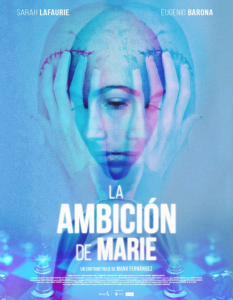
“La Ambición de Marie” (“Marie’s Ambition”) (short) (3/5) US Premiere
(Spain)
Letterboxd (3/5), Imdb.com (6/10), TMDB.com (6/10), Imdb critics review
#BrentMarchant #clff42 #ChicagoLatinoFilmFestival #MariesAmbition #LaAmbiciondeMarie #filmshort #Spain #chesschampion #tattoo #antidopinginquiry
When Marie (Sarah Lafaurie), an aspiring French chess master who has met with mixed career success, is approached by a mysterious stranger (Eugenio Barona) with a dubious proposal to up her game, she’s simultaneously intrigued and perplexed. The shadowy figure, who claims to represent an antidoping organization that investigates the use of illicit substances, practices and techniques in the world of sports, says he’s anxious to determine if it’s possible to employ a clandestine enhancement method for significantly improving one’s chess skills, and he wants to know if Marie wants to give it a try to see if it works. Given that chess is one sport in which doping has not been an issue (largely because it’s believed it wouldn’t have any appreciable impact), Marie wonders about the value of such a dubious undertaking. At the same time, though, given her ambition to rise to prominence in the sport, she agrees to the idea. But little does she – or the mystery man – know what’s about to unfold. To be honest, though, it’s not hard to figure out what’s actually transpiring in director Manu Fernández’s Faustian tale, although the particulars of how its plot developments come to pass seem a bit … odd … and somewhat underexplained. In light of that, then, this project probably would have worked better as either a longer short or even a feature-length piece with greater elaboration. As it stands now, however, “La Ambición de Marie” feels somewhat undercooked and in need of further detail to make its moves clearer and more engaging.