



“Father Mother Sister Brother”
(USA/UK/Italy/France/Ireland/Germany)
Metacritic (7/10), Letterboxd (3.5/5), Imdb.com (7/10), TMDB.com (7/10), Imdb critics review
#BrentMarchant #FatherMotherSisterBrother #JimJarmusch #TomWaits #AdamDriver #MayimBialik #CharlotteRampling #CateBlanchett #VickyKrieps #familyrelations #dysfunction #NewJersey #Dublin #Paris #twins #comedydrama #minimalistcinema #andBobsyouruncle
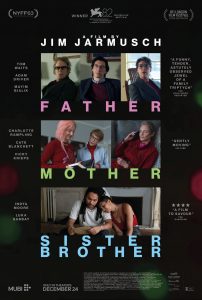
Try as I might, there are some filmmakers whose work I often find difficult to appreciate. Their movies just seem to be … lacking something. But, every so often, these auteurs surprise me, coming up with pictures that I find enjoyable, engaging or even enlightening. And that’s how I would characterize the latest work from writer-director Jim Jarmusch. Little occurs in many of his offerings, arguably making them the epitome of minimalist cinema, and a number of his efforts, frankly, have left me cold and uninvolved, no matter how much of a chance I give them. However, there are also times when Jarmusch somehow successfully manages to make something out of virtually nothing, as he quite capably does in this release. This gentle comedy-drama essentially consists of three unrelated but complementary vignettes about the dysfunctional but puzzlingly endearing relationships between adult children and their emotionally and/or corporeally distant parents. In the first segment, titled “Father,” the long-estranged adult children (Adam Driver, Mayim Bialik) of a crusty, easily confused, aging dad (Tom Waits) pay an uneasy visit to his idyllic rural New Jersey home. Their polite but strained reunion at his cluttered, disheveled house cause them considerable concern. However, little do they know that appearances can be deceiving, especially when a quietly crafty senior is involved. This is followed by “Mother,” which depicts the annual visit of sisters (Cate Blanchett, Vicky Krieps) to the home of their quietly judgmental widowed mother (Charlotte Rampling), a well-off best-selling author, for high tea. Although all three of them live in Dublin, for some reason, they only see each other once a year for this awkward annual event. And rounding out this triptych is “Brother Sister,” which follows twin siblings (Indya Moore, Luka Sabbat) on a visit to the vacated Paris apartment of their deceased parents, both of whom were killed in a private plane crash in the Azores. While the now-orphaned kids seem to have been on good terms with mom and dad, it’s also apparent that there’s much they didn’t know about them when alive. It’s not until they sort through some revealing and highly personal belongings that surprising secrets surface, perhaps the most distanced relationship of the three presented in the film. True to the director’s form, not a lot happens in this picture, yet, given the nature of the narratives featured here, there’s an uncanny sense of intimacy on display – quite an ironic feat for a picture in which viewers don’t really get to know any of the characters particularly well. In part that’s due to a number of overlapping elements (some of which are very specific in nature) that run through all three sequences, effectively illustrating the commonality (or perhaps universality) that’s intrinsic to relationships like these, something to which many of us can probably personally relate. Meticulous attention is also paid to the details of such attributes as set design, recurring prop use, camera work, thematic vectors, and even the use of common, everyday colloquialisms. It’s a demonstrably thoughtful practice that serves to compellingly draw viewers into the story, as if they were themselves present when these events are actually unfolding. Indeed, there’s an intangible quality to all of this that’s unmistakenly captivating, something unexpected from a film in which so inherently little is going on but that nevertheless feels so undeniably full and familiar. In many ways, “Father Mother Sister Brother” is the filmmaker’s best work in over a decade, on par with such releases as “Paterson” (2016) and “Only Lovers Left Alive” (2013) (and a far cry from some of the cinematic experiments that didn’t fly). Moviegoers who have little patience for what they watch, admittedly, could find this work tedious and insubstantial. But those who like movies that feel like a good book will probably enjoy this one immensely. And, to sum up, as many of the characters in this offering would likely say, “And Bob’s your uncle!”