



“The History of Concrete”
(USA)
Metacritic (7/10), Letterboxd (3.5/5), Imdb.com (7/10), TMDB.com (7/10), Imdb.com critics review
#BrentMarchant #TheHistoryofConcrete #JohnWilson #documentary #NewYork #TheHallmarkChannel #sidebarstories #HowTowithJohnWilson #HBO #televisionseries #HLMecken #BillGeist #CBSSundayMorning #MichaelMoore #WritersGuildofAmericastrike #ancientRome #industrialfilm #powerwasher #chewinggum #sidewalksurface #literaryspringboard #narrativetangent #Ohio #California #Rome
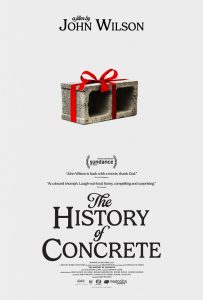
How curious it is when a creative mind is able to transform observations about the mundane into insightful musings of surprising depth and meaningfulness. Sometimes these works are born out of pure inspiration, while others arise out of practical necessity and consequently garner far-reaching public attention, taking on lives of their own. The writings of author H.L. Mencken come to mind, as do the whimsical video essays of Bill Geist from CBS Sunday Morning and even the satirical documentaries of Michael Moore. So it is now also for filmmaker John Wilson. After spending three seasons working on the documentary television series How To with John Wilson on HBO (2020-2023) and with the royalty checks from it subsequently dwindling, he needed a new gig to carry on with his career. But, given the 2023 Writers Guild of America strike, opportunities for new work vanished, leaving him in limbo and in need of an income source. To help out its members during the strike, the WGA sponsored a workshop on how to create movie scripts for The Hallmark Channel, a venue with strict formulaic guidelines to be followed. Wilson enrolled and decided to adapt elements of the formula to make a feature film of his own – a documentary about a subject with which he had become quite familiar as a landlord: concrete, a building material that he worked with often in maintaining and repairing his aging property. To most of us, this might seem like an obscure subject to reflect on, especially as the basis for a feature film. However, as Wilson observes, concrete is something with which we’re all ubiquitously surrounded in our environment, something that dates as far back as the days of ancient Rome and is still present today, both in new applications and in the enduring constructions of years gone by. Yet, despite its pervasive, perpetual presence, this substance is something that we largely take for granted and whose utility and endurance we don’t fully appreciate. So, with these underlying precepts in mind, Wilson crafted this offering with a series of segments that enlighten viewers with more than they ever knew (or probably ever wanted to know) about concrete. Of course, to keep the project from playing like a tedious industrial film, the material is presented in Wilson’s inimitable deadpan style, backed by suitably unassuming imagery and wry prose not unlike that used by Mencken, Geist and Moore. The emphasis on concrete itself in these sequences is limited in scope, focusing more on the colorful personalities who work with it their various respective capacities, such as an animated power washer who specializes in gleefully obliterating wads of dried, hardened chewing gum from concrete sidewalk surfaces. These sidebar stories thus serve as literary springboards to launch audiences into narrative tangents that have concrete as their foundational bases but are imbued with eminently more whimsical attributes and treatment. Many of this offering’s segments were shot in Wilson’s hometown of New York, but others were filmed further afield in locales like Ohio, California, and, of course, Rome, again showing how widespread this building material’s use truly is. Wilson also injects himself and his personal experiences into the film, including depictions of his struggles to market this production and find a way to get it picked up for distribution. Admittedly, the picture begins running out of steam in the final act (I guess there’s only so much that can be said on the subject, no matter how imagination is infused), but even getting to this point is a truly remarkable accomplishment. And, thankfully, Wilson found a way to bring this delightful production to the public. In doing so, “The History of Concrete” shows us how to appreciate the innate beauty in the unappreciated – and how the supposedly mundane may not be as mundane as we might think.