



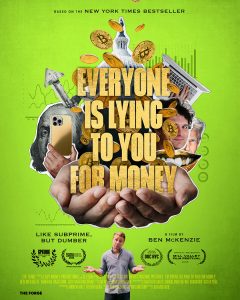
“Everyone Is Lying to You for Money”
(USA)
Metacritic (7/10), Letterboxd (3.5/5), Imdb.com (7/10), TMDB.com (7/10), Imdb.com critics review
#BrentMarchant #EveryoneIsLyingtoYouforMoney #documentary #BenMcKenzie #cryptocurrency #AlexMashinsky #Celsius #SamBankmanFried #FTX #Bitcoin #ThatGuyFromTheOC #MattDamon #TomBrady #ShaquilleONeal #NayibBukele #ElSalvador #EasyMoney #BitcoinCity #scam #Ponzischeme #investor #faith #monetarysystem #Congress #MichaelMoore #BillMaher #JohnWilson
Few of us probably think about money as a belief in the notion of it as a tangible form of trust. And, consequently, many of us probably take that trust for granted, that the value behind it will always be there, just as it’s assumed to be there with any other financial commodity that has the word “currency” as part of its identity. So it has been – and still is – for countless investors who have poured funds into “cryptocurrencies,” such as Bitcoin, those electronic forms of non-governmental and non-bank transactional/investing tender that have sprung up in recent decades. But, without such traditional institutional backing behind them, are they safe? Can they truly be trusted in the same way we look at conventional money? That’s what this debut writing-directorial effort from actor Ben McKenzie seeks to answer. In an era when many of us have lost faith in the established monetary system, the promise and allure of cryptocurrencies has had considerable appeal for those looking to get ahead financially. However, after a bad investing experience in his earlier years, McKenzie was skeptical about this new form of currency when it became a hot topic, one even promoted in commercials by such celebrities as Matt Damon, Tom Brady and Shaquille O’Neal. Even the President of El Salvador, former advertising executive Nayib Bukele, was so enamored with cryptocurrency that he made Bitcoin the country’s official legal tender after his election in 2019, even proposing grand plans to develop and construct an entire community based on it called Bitcoin City. And, in the wake of these outlandish developments, which seemed based more on marketing than economics, McKenzie had good reason to be skeptical, especially when no one could explain how these currencies work in an understandable way (his undergraduate degree in economics notwithstanding). He consequently looked into them in greater detail, and, as his investigation wore on, with the collapse of crypto giants like Celsius and FTX (and the convictions of their respective CEOs, Alex Mashinsky and Sam Bankman-Fried), McKenzie could see, as he initially suspected, that these currencies were essentially scams that left many investors high and dry. These scenarios – much like Ponzi schemes – were largely built on an implied but ultimately fraudulent form of trust, a variation on the kind typically associated with legitimately sanctioned currencies. This examination subsequently led to McKenzie testifying before Congress, writing a book on the subject titled Easy Money (2023) and the making of this documentary, much in the style of filmmakers Michael Moore, Bill Maher and John Wilson. In essence, the film’s title says it all, but, at least early on in the film, it doesn’t venture far beyond that rather obvious conclusion. Instead, it focuses heavily on the early days of McKenzie’s professional life as an actor, one who gained particular acclaim for his role on the television series The O.C. (2003-2007), and footage of his home life. But, as viewers dive deeper into the picture, it finally gets on track and delves into the nitty-gritty behind the operation of these scams, the point where the film starts to become considerably more engaging and informative. Of course, in making the case publicly as a critic of cryptos and advocate for greater official oversight, he came under attack from pundits for his theatrical background, with many questioning, what does “That Guy From The O.C.” know about this stuff? (In hindsight, this criticism probably helps to provide context for the opening 30 minutes of the film, although that portion of this offering likely could have been cut and/or reworked to better explain its inclusion.) Nevertheless, “Everyone Is Lying to You for Money” sounds a strong clarion call about the potentially dangers of these financial products and does so in an entertaining and accessible way once it finds its footing. And, in the end, if nothing else, thanks to this film, would-be investors can’t say that they haven’t been warned.