



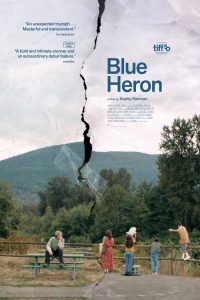
“Blue Heron”
(Canada/Hungary)
Metacritic (6/10), Letterboxd (3/5), Imdb.com (6/10), TMDB.com (6/10), Imdb critics review
#BrentMarchant #BlueHeron #VancouverIsland #Canada #BritishColumbia #domesticdrama #problemteen #shiftingperspective
Sometimes there are no easy answers in life. Such circumstances can be maddening, leaving us frustrated, perplexed and wanting for a lack of adequate explanation. Yet, as on point as that description may be, it doesn’t suffice. Nor does it necessarily translate into good storytelling or filmmaking, as is the case in this debut feature from director Sophy Romvari. When a family of Hungarian descent relocates to British Columbia’s Vancouver Island in the 1990s, they hope that the new environment will prove beneficial for their troubled teenage son, Jeremy (Edik Beddoes), who routinely engages in unexplained antisocial and sometimes-dangerous behavior, despite his apparent capacity for kindness and compassion. Jeremy is quite a handful for his stability-searching parents (Iringó Réti, Ádám Tompa), who have tried everything – to no avail – to understand him and to get him the help he needs. He’s also something of an enigma to his three younger siblings, his two brothers (Liam Serg, Preston Drabble) and, most notably, to his sister, Sasha (Eylul Guven), a sweet, sensitive girl who’s especially curious about her eldest brother’s erratic behavior. So what’s up with the unsettled young man? That’s where the elusive easy answers come into play. And it’s an issue that haunts Sasha from her youth and on into adulthood, where her elder self (Amy Zimmer) has become a filmmaker. When all grown up, she meets with a group of mental health professionals and social service workers for insight on a documentary she’s making about a “case” she’s chronicling, seeking advice on how to best handle the story of a patient whose profile is a virtually identical match to that of her brother. It’s at this point, however, when the film begins losing its way, blending the art of the elder Sasha with the memories of her younger self in an almost surrealistic (and, at times, incoherent) fashion. One can presume from this that Sasha’s adult self is likely a stand-in for filmmaker Romvari herself, adding another level of muddying ambiguity to the storytelling mix, making for an offering that becomes trying to fathom. It may provide a fitting parallel to the conditions faced by Jeremy’s parents themselves, but is this good filmmaking? Some might see this as a masterful work of cinema, an interplay of reality, biography and artistic interpretation, but I honestly found it somewhat confusing, despite an earnest, ambitious attempt at fusing the various aforementioned elements. In that sense, “Blue Heron” feels somewhat contrived and unclear about its intent, with a choppy, sometimes-distracting flow to its narrative. To its credit, this is a gorgeously filmed release gloriously depicting the landscape of western Canada, along with meticulous attention to its detailed production design, backed by a diverse and often-perfectly suited soundtrack. But the essential substance of this release could use some much-needed refinement and clarity, with a little more shoring up, a little less ethereal treatment and smoother transitions between sequences. It’s indeed true that this work effectively brings the lack of easy answers front and center for viewers, but that doesn’t mean we should be swallowed up by them in the process.