



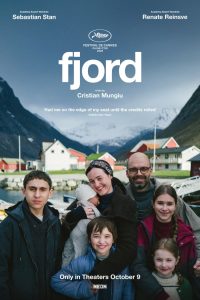
“Fjord”
(Romania/France/Norway/Denmark/Sweden)
Metacritic (7/10), Letterboxd (3.5/5), Imdb.com (7/10), TMDB.com (7/10), Imdb.com critics review
#BrentMarchant #Fjord #SebastianStan #RenateReinsve #suspectedchildabuse #Romania #Norway #EvangelistChristians #prayer #punishment #Biblestudy #ChildProtectionServices #CannesFilmFestival #PalmedOrwinner #domesticdocudrama #prisonsentence #witchhunt #fosterfamilies
At what point does genuine concern and compassion for the welfare of children cross the line into an overstated politically correct witch hunt built on, at best, circumstantial evidence? Should government agencies be given carte blanche powers to tell parents how to raise their children (particularly when cultural, religious and philosophical considerations are involved), and when (and what kind of) limits should be imposed? And can the statements of allegedly victimized children be unquestionably trusted without undeniably convincing evidence to back up their contentions, especially if they have axes to grind with their parents? Such are the questions raised in this fact-based domestic docudrama from writer-director Cristian Mungiu, a picture that captured the prestigious Palme d’Or and FIPRESCI Prize at this year’s Cannes Film Festival. When the Gheorghiu family relocates from Romania to Norway, they encounter a significant cultural shift, one that leaves behind their conservative, traditional Eastern European values in favor of those typical of more “progressive” Western European ideals. This is quite a change for Romanian-born Mihei (Sebastian Stan) and even his Norwegian wife, Lisbet (Renate Reinsve), who are raising their five children in a loving Evangelist Christian home that’s heavy on prayer and rigorous Bible study. However, the children’s failure to abide by this strict religious regimen and their parents’ disapproval of modern, worldly values can get the kids in trouble and result in various forms of “punishment.” But what exactly are those “corrections,” and how physically and emotionally troubling are they? When the two eldest children, Elia (Vanessa Ceban) and Emmanuel (Jonathan Ciprian Breazu), show up at their new school with apparent bruises, they’re questioned by officials about how they sustained these injuries, testimony that’s somewhat vague and open to interpretation (never mind the fact that they’re currently engaged in aggressive wrestling exercises in gym class and they’re upset that their parents have forbid them from attending the birthday party of their new neighbor, Noora (Henrikke Lund Olsen), with whom Elia has apparently taken more than a casual liking). In light of the possibility of suspected child abuse, Child Protection Services and the police step in to investigate, setting off a chain of events that results in the kids being relocated to foster families and lands Mihei and Lisbet in court, facing the possibility of prison sentences at a time when all the suitably perplexed children want is to be reunited with their parents. “Fjord” thus takes an approach to a situation that examines its dynamics from all angles (though some observers have somewhat unfairly called the film a biased defense of conservatism, potential liberal overreach notwithstanding). It also explores the role that cultural and religious differences can play in such scenarios and the persecution that minority viewpoints might undergo at the hands of more powerful socially sanctioned adversaries. And, considering how circumstances are handled, the picture shows that there are no easy answers under conditions like these, giving viewers much food for thought. The script’s meticulously balanced examination of all the components involved in scenarios like this, as well as the ramifications that emerge from them, is indeed impressive, even if some of them may be a tad belabored at times. There are also several secondary story threads that add little and could have been scaled back or eliminated, particularly given this offering’s hefty 2:26:00 runtime. Nevertheless, the film’s stunning cinematography and fine performances by Stan and Reinsve are worth a look in and of themselves, qualities that have helped make this release a strong awards season contender. “Fjord” is admittedly an often-frustrating, arguably infuriating watch at times, naggingly trying viewer patience, regardless of one’s individual leanings. But its greatest strength lies in illustrating how situations like this – and the potential solutions to address them – may not be as cut and dried as we might like to think they are, a tremendous resource for encouraging greater tolerance on both ends of the sociopolitical spectrum in an age where that commodity is, regrettably, all too often in short supply.