



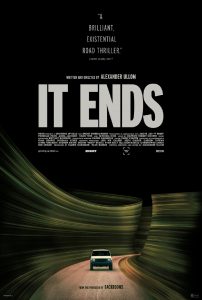
“It Ends”
(USA)
Metacritic (2/10), Letterboxd (1/5), Imdb.com (2/10), TMDB.com (2/10), Imdb critics review
#BrentMarchant #ItEnds #roadtrip #horrortrope #AlexanderUllom #NoExit #JeanPaulSartre #GenerationZangst #existentialiststageplay #debutfeature #zombie #afterlife #eternity
In the interest of full disclosure up front, I’ll do my best to assess this release without being overly unkind. To be honest, this debut feature from writer-director Alexander Ullom has almost assuredly earned itself a spot on my “Worst of 2026” list. Loosely based on the 1944 existentialist stage play No Exit by Jean-Paul Sartre, “It Ends” tells the story of four twenty-something friends (a term I use loosely) (Phinehas Yoon, Mitchell Cole, Akira Jackson, Noah Toth) who embark on a late-night drive but soon find themselves lost on a never-ending highway through a thickly forested woodland from which there’s no apparent escape (i.e., “no exit”). In an effort to spice up the plot, the narrative subsequently attempts to infuse a few horror tropes, but, sadly, these poorly handled elements aren’t particularly scary or the least bit enlightening in defining the essence of the plot. (At one point, for instance, the puzzled quartet is attacked by a band of fleet-footed zombies, forcing the fearful foursome to flee for their lives. It’s an element that’s reincorporated or inferred throughout the film but that, frankly, has little ultimate bearing on the story. What’s more, the sequence is so ineptly executed that it’s ultimately more confusing than frightening.) Not long thereafter, when matters settle down and these lost souls begin discussing the nature of their bewildering circumstances, they’re forced to begin considering that they might be trapped in some kind of alternate existence, even a hellish version of the afterlife. That possibility, in turn, prompts yet another round of long-winded, uninteresting existential discussions that are part metaphysics, part petty bickering and part overwrought Generation Z angst, all set against the backdrop of an incessant road trip for which practical concerns like having enough fuel for the journey (wherever it may be headed) are apparently irrelevant. And that, in a nutshell, fittingly characterizes the dynamics of this wholly pretentious offering, despite what may have started out with a worthwhile premise and good intentions. The blame here lies largely with the woefully undercooked, meandering screenplay. For example, most of the excessive group discussions are lame and unfocused and lack engaging substance, light years removed from the eloquence and insight of the source material that inspired this production. Then there’s the seriously underused horror aspect, which might have added more interest if more skillfully and integrally employed. The filming techniques are also stunningly puzzling, with much of the action shot too dimly and/or too up-close, so much so that, in sequences like the zombie attack, it’s difficult to tell what’s happening. And, of course, there are plot holes aplenty, which are genuinely inexcusable, even for a first-time filmmaker. To its credit, though, the picture gets one thing right: it’s a testament to Sartre’s renowned contention that “hell is other people,” as these characters come to find out for themselves, bringing fresh meaning to that statement and to the audience (indeed, I can’t imagine being stuck with individuals like these for eternity; 89 minutes was more than enough for me). But that spot-on irony is not nearly enough to save this effort, especially since it even more ironically gives viewers reason to skip this release. Perhaps, as a senior, the generational nuances at work here were lost on me, but, that aside, while screening this offering, I also couldn’t help but keep asking myself, “Are we there yet?”