



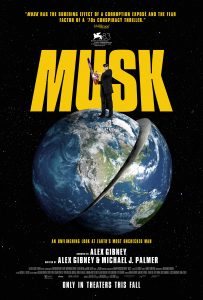
“Musk”
(USA)
Metacritic (8/10), Letterboxd (4/5), Imdb.com (8/10), TMDB.com (8/10), Imdb.com critics review
#BrentMarchant #Musk #ElonMusk #capitalist #sociopath #worldsrichestman #Spacex #Tesla #Twitter #DOGE #DonaldTrump #inventor #engineer #stockhuckster #AlexGibney #documentary #narcissist #visionary #captainofindustry #disinformation #PTBarnum #cautionarytale #clout #TheManWhoCouldWorkMiracles #ambition #divineintervention #GoingClear #EnronTheSmartestGuysintheRoom #videogame #simulation #enigma #charisma #capitalist
When an individual is allowed/enabled to amass and exert vast social, political and economic influence over society, it would sensibly behoove us to acquire as much knowledge as possible about said person. But, in many cases, we’re often distracted by the charisma of such figures, spellbound by their stories, accomplishments and visions. Those impressions, however, may leave us with an incomplete or distorted image of these individuals as we tend to buy into their carefully crafted personas more than what may actually be true. And, as this new documentary from writer-director Alex Gibney asserts, that’s very much the case where engineer/inventor/investor Elon Musk is concerned. As the world’s richest man and often called the planet’s greatest capitalist, according to the filmmaker’s assessment, in a comparatively short time span, Musk has risen to a level of tremendous, virtually unchecked power – perhaps even outstripping that of the world’s most formidable leaders – to be able to effectively call the shots in many areas of life. Having built a business empire through the founding and/or acquisition/management of such enterprises as Spacex, Tesla Motors and Twitter/X, as well as his efforts as an advisor/confidante to President Donald Trump and head of the US government’s dubiously named Department of Government Efficiency (DOGE), the South African-born entrepreneur has emerged as an omnipresent icon in contemporary American (and, ostensibly, global) society. But what do we know about him as an individual? And have his accomplishments truly lived up to their expectations and promises? Those are the questions this release seeks to address, and, as the results show, they don’t necessarily bear out the claims and the hype. In fact, the film paints a very different picture from what many of us have been led to believe. With a runtime just a hair shy of four hours (thank heavens for intermissions), “Musk” undertakes a systematic dismantling of its subject, presenting a wealth of disinformation about and insights from those who claim to know the protagonist best. Rather than being a stalwart, altruistic, visionary captain of industry, the film portrays Musk as a self-serving narcissist with arguably sociopathic tendencies (not unlike conditions in the environment in which he grew up). Like those who P.T. Barnum astutely warned us about, the filmmaker labels Musk as a master stock huckster whose stories are so compelling, convincing and provocative that he has been able to convince many to follow his lead as investors just on the basis of his promises alone, whether or not they hold water. And, because of that, he has accumulated the financial power to pursue his visions and whims, no matter how realistic or unrealistic they may be. In Gibney’s view, that kind of clout has made Musk into a present-day personification of the lead character in the cinematic classic “The Man Who Could Work Miracles” (1936), who, thanks to experimental divine intervention, personal initiative and unbridled ambition, came to believe he could accomplish anything, regardless of how wise or beneficial his plans may be. But can viewers believe everything the filmmaker has to say about all this? As a director known for taking on controversial subjects in documentaries like “Going Clear: Scientology & the Prison of Belief” (2015) and “Enron: The Smartest Guys in the Room” (2005), this latest offering is very much in the same vein as those previous works. What’s more, as revealed early on in the picture, the filmmaker freely admits that Musk was openly (and hostilely) unwilling to work with him on this project, which, despite this courageous acknowledgment, could suggest that a certain degree of axe-grinding may have been behind this production. In fact, because of this lack of cooperation, Gibney was backed into creating a sort of virtual version of Musk by editing together sound bytes from recordings of everything the protagonist supposedly ever said, placed in a videogame setting, a suitable backdrop drop for this characterization given his interest in this pastime (and a belief that we all may be part of a vast simulation of which most of us are unaware). Some might question this treatment as a mockery of the subject, but, when paired with complimentary acknowledgments of some of the protagonist’s achievements, one might also see this element as a genuine metaphorical depiction. Whatever conclusions audiences may draw from all this, if the filmmaker is given the benefit of the doubt, this release could be viewed as an authentic, albeit cringeworthy cautionary tale, one whose content should be taken seriously. Granted, the film could arguably have been pared back somewhat (especially in the disorganized opening hour), but, once the picture finds its groove, it’s hard to look away and doesn’t at all seem like it’s as long as it is. Indeed, it’s often difficult to know exactly what to make of an enigma, and Musk certainly fits that bill. But, if nothing else, it should raise some important questions for all of us to ask before we give away the store and there’s no going back.