



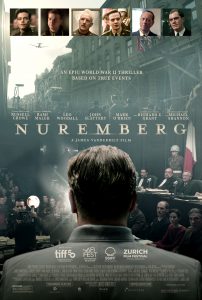
“Nuremberg”
(USA/Hungary)
Metacritic (10/10), Letterboxd (5/5), Imdb.com (10/10), TMDB.com (10/10), Imdb.com critics review
#BrentMarchant #Nuremberg #HermannGoring #RudolfHess #RussellCrowe #RamiMalek #MichaelShannon #RichardEGrant #JusticeRobertJackson #DrDouglasKelley #ThirdReich #FinalSolution #concentrationcamp #psychiatrist #competencyfortrial #warcrimestrial #crimesagainsthumanity #WorldWarII #Germany #AlliedForces #USA #USSR #France #UK #cautionarytale #historicaldrama #psychologicalthriller
Itʼs widely maintained that those who don’t learn from history are destined to repeat it (despite the fact, unfortunately, that we also all too often disregard such sage advice). But, if there’s any message to be taken away from this latest offering from writer-director James Vanderbilt, this would be it, especially given the prevailing sociopolitical climate. This engaging historical drama/psychological thriller serves up a potent cautionary tale about the need to recognize, embrace and take seriously the lessons to come out of the Nuremberg trials in which former Nazis were prosecuted for crimes against humanity in the wake of World War II, the first time proceedings of this kind were ever conducted (however, viewers should note that this is not a remake of the 1961 iconic movie classic “Judgment at Nuremberg”). Specifically, the film follows the efforts of US Supreme Court Justice Robert Jackson (Michael Shannon) to convene an international tribunal for this purpose, one consisting of judicial representatives from the Allied Forces of the US, the UK, France and the USSR. In the first of what would become a series of 12 trials, the tribunal prosecutes 22 Nazi defendants, including Reichsmarschall Hermann Göring (Russell Crowe), second in command to deceased Führer Adolf Hitler. Göring’s capture at the end of the war represents a major coup for the Allies in their quest to secure justice, but, to assure his competency to stand trial, the US military assigns psychiatrist Dr. Douglas Kelley (Rami Malek) to evaluate his mental state, a process that accounts for much of the film’s narrative (based on author Jack El-Hai’s 2013 nonfiction title, The Nazi and the Psychiatrist). It’s a process that ultimately proves to be quite personal as well as professional, with some surprisingly fascinating revelations emerging from the duo’s intense and occasionally intimate dialogues. But, as becomes apparent, the picture also sheds a chilling light on the narcissistic and sociopathic traits characteristic of both Göring and his colleagues, attributes that Kelley finds troubling not only in the personas of the Nazi war criminals, but also quietly lurking in others, a wholly unexpected and disillusioning insight for the idealistic and fair-minded doctor. However, given the depth and relevance of the content here, I’m admittedly perplexed at the reaction this film has received. It has been shut out of nominations in all of the major awards competitions announced thus far, despite the undeniable strengths in its writing, editing, production design, and musical score, as well as its outstanding performances by the three principals and in the supporting portrayals of Richard E. Grant, John Slattery, Leo Woodall and Colin Hanks. But, more than that, I fail to see the questionable justification behind a number of the criticisms that have been leveled against this title. What many have called boring I’ve found mesmerizing; what some have likened to a dry cinematic term paper I’ve found to be consistently engaging and profoundly affecting; and what some have said is a slow-moving slog is, in my view, a consistently paced, attention-holding release, quite an accomplishment for a picture with a 2:28:00 runtime. From these dubious observations, I can only conclude that this is yet another example of the American public’s general lack of interest in anything of a historical nature, which, as a college history major, I find sad given its all-too-frequent tendency to repeat itself. Indeed, it’s a sentiment perhaps best summed up by a quote from British historian and philosopher R.G. Collingwood that appears before the start of the closing credits: “The only clue to what man can do is what man has done.” “Nuremberg” shows us that; let’s hope we’re paying attention.