



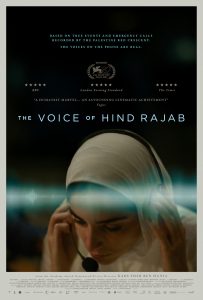
“The Voice of Hind Rajab” (“Sawt Hind Rajab”)
(Tunisia/France/USA/UK/Italy.Saudi Arabia/Cyprus)
Metacritic 10/10), Letterboxd (5/5), Imdb.com (10/10), TMDB.com (10/10); Imdb.com critics review
#BrentMarchant #TheVoiceofHindRajab #Gaza #WestBank #emergencyservices #RedCrescent #warzonerescue #GoldenGlobeAward
Some movies entertain. Some movies enlighten. And some movies haunt you to the core in ways that are difficult to put into words. That description is most aptly applied to the latest offering from writer-director Kaouther Ben Hania, a fact-based dramatization that skillfully, sensitively yet effectively straddles the line between documentary and narrative features in a chillingly realistic story that can’t help but move viewers and leave an indelible impression on one’s soul. In January 2024, volunteer members of the Palestinian Red Crescent Society stationed in Ramallah in the Occupied Territories’ West Bank receive a harrowing phone call from a terrified six-year-old girl, Hind Rajab, who is trapped in a car with five deceased relatives killed in an ambush by Israeli Defense Forces as the family sought to flee the Gaza Strip while under siege from IDF troops. The emergency response workers, Omar (Motaz Malhees), Rana (Saja Kilani), Nisreen (Clara Khoury) and Mahdi (Amer Hlehel), desperately struggle to get an ambulance to the frightened child to evacuate her from an embattled location riddled with ubiquitous gunfire and menacing tanks, circumstances that deeply scare her and that she’s understandably unable to comprehend. Unfortunately, the Red Crescent staff’s hands are tied; they’re located 52 miles from Gaza yet have been assigned to process rescue efforts from a distance given the closure of the organization’s operations in the battle-torn region. And, if their remote location weren’t challenging enough, they’re frustrated by an elaborate “coordination” protocol that they must follow to safeguard rescue vehicles entering the combat zone, forcing them to wait for a “green light” to proceed, all the while listening to Hind’s panicked cries for help that doesn’t come. But what makes this film so particularly unsettling is that Hind’s pleas during the ordeal are the actual tapes of her voice that were recorded by Red Crescent as the incident unfolded. Knowing that makes this an especially anguishing cinematic experience for viewers, particularly since the audio of Hind’s voice is the only tie that audience members and the rescue workers have to her as these unspeakable atrocities are inflicted upon her, leaving both characters and viewers with an unfathomable sense of utter helplessness. It should thus go without saying that this is a truly difficult watch, one that may be more stressful than what many moviegoers (particularly sensitive viewers) can realistically bear. At the same time, though, this is also an exceedingly poignant vehicle for driving home the depth of the ineffable inhumanity taking place during this barbaric scenario. It naturally begs the question, how could anyone (or any military or political body) possibly be so inherently and uncaringly cruel? As a consequence, one can’t help but be powerfully affected by this release, in terms of invoking the seemingly incongruent combination of both profound compassion and suitably justified outrage. It’s the kind of film that we all must see to get an accurate appreciation of the callous brutality that’s thoughtlessly transpiring around us (and, as recent events have shown, not just in Gaza, either). For a picture like this, it’s difficult to talk about it in terms of accolades and honors, but, in its own way, “The Voice of Hind Rajab” has deservedly garnered considerable recognition at film festivals, in awards competitions and from film critics organizations, including a well-earned Golden Globe Award nomination for best foreign language film. It’s regrettable that it takes material like this to make us aware of the pain and horror that’s going on unchecked in our world today. But that knowledge is ultimately far more valuable to us than willfully turning a blind eye and looking the other way. We stand to lose a lot more by following that course, and, in this day and age, that’s simply unacceptable.