



‘Midwinter Break’ asks, ‘what do we really want out of life?’
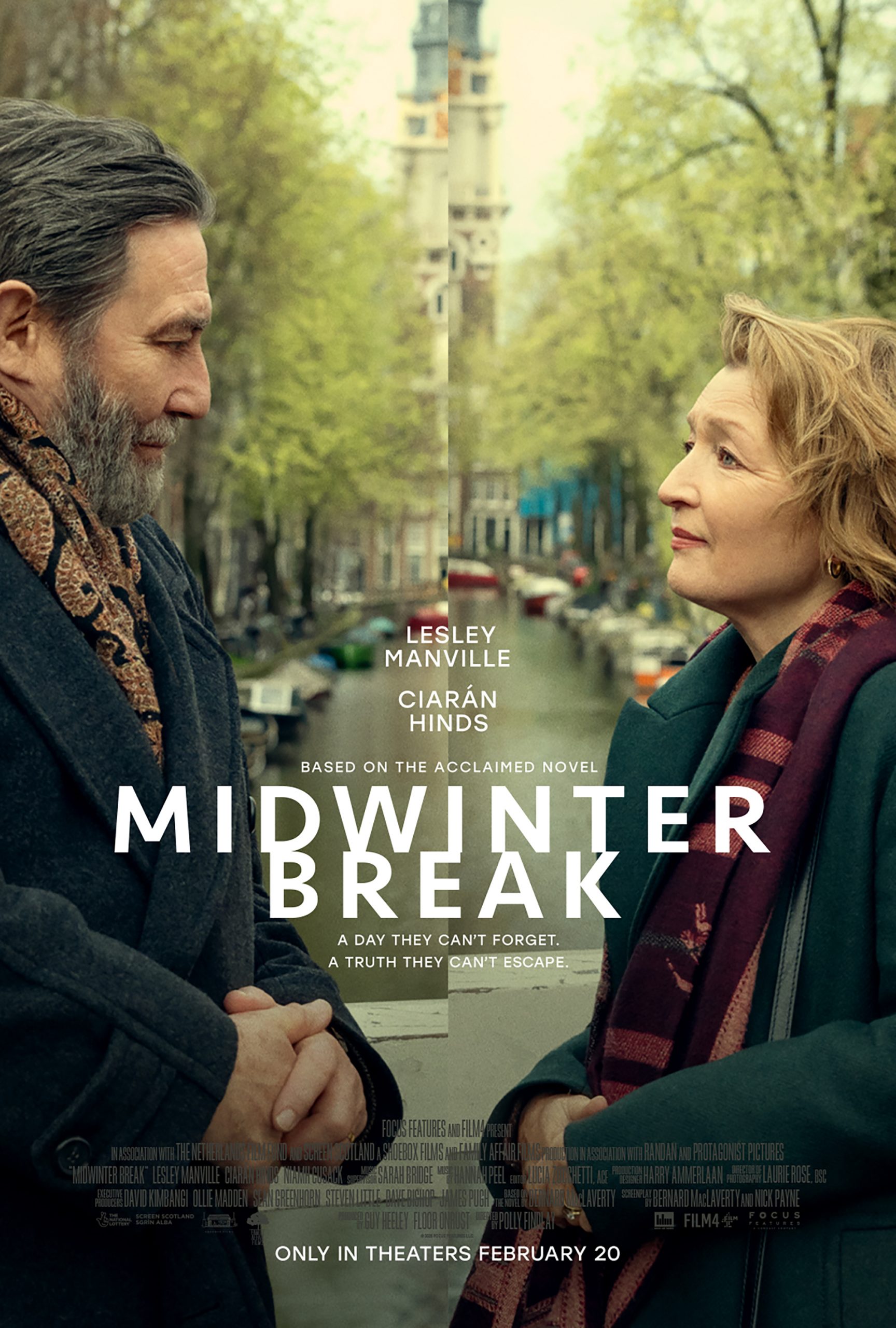
“Midwinter Break” (2026) (Netherlands/UK). Cast: Lesley Manville, Ciarán Hinds, Niamh Cusack, Ed Sayer, Julie Lamberton, Ozan Topaloglu. Director: Polly Findlay. Screenplay: Bernard MacLaverty and Nick Payne. Book: Bernard MacLaverty, Midwinter Break (2017). Web site. Trailer.
Has anyone noticed how it’s becoming increasingly rare these days to find movies that present stories with insightful, contemplative narratives? Granted, pictures like this may not appeal to everyone (especially producers salivating over the hopes of big box office numbers), but the considerations these releases address ultimately account for significant and meaningful aspects of our lives and the nature of existence, big issues that aren’t – and shouldn’t be – easily dismissed. That’s especially true now, given the hunger that many of us have for offerings that provide profound food for thought on both practical and existential levels. Fortunately, though, there’s one new release that amply helps to fill this void, the spiritually oriented relationship drama, “Midwinter Break.”
Based on the acclaimed 2017 novel of the same name by author Bernard MacLaverty, the film tells the bittersweet story of Stella (Lesley Manville) and Gerry (Ciarán Hinds), a long-married couple from Glasgow, Scotland who fled their home in Belfast, Northern Ireland years ago when the religion-driven havoc caused by “the Troubles” upended their lives. The impact of that tumultuous upheaval took quite a toll on their younger selves, coming at a time when a youthful Stella (Julie Lamberton) was pregnant and young Gerry (Ed Sayer) saw his promising career as an architect go up in flames, both literally and figuratively. And so, after several harrowing incidents, the danger got to be too much for them, prompting them to relocate to the safety and security of their new adopted home.
Glasgow provided the couple with a safe haven out of harm’s way and a good place to raise a family. But, over time, Stella and Gerry began falling prey to insidious new threats – stagnation and a growing distance between them, conditions that have steadily worsened through the years, especially now that they’ve reached the empty nest stage of their lives. And, even though they genuinely appear to still be in love with one another, there’s not much else sustaining their increasingly tenuous connection.
These circumstances have become a source of considerable concern for Stella, who craves a greater sense of meaning and fulfillment out of life, especially now that she’s getting older. That’s particularly true in matters of spirituality. As a devout Catholic who grew up and spent much of her adult life living in largely Protestant enclaves, she’s come to believe that something eminently deeper is noticeably missing from her life, something that may have been long withheld and that she wants to discover and understand while she still has the chance to do so. What’s more, she’s frustrated that this is a yearning Gerry doesn’t share with her, making her feel even more alone and isolated, especially now during the height of the Christmas holidays. Nevertheless, despite these conditions, Stella feels compelled to find the missing piece of the puzzle, even if that means having to do so on her own.
Gerry, meanwhile, is rather oblivious to what’s going on with his wife. Because she hasn’t said anything to him about her concerns, he essentially assumes all is well. For his part, he’s generally content to comfort himself with life’s simple pleasures – long naps, reading, good music, and, perhaps most notably, the contents of the nearest whiskey bottle. But, even if these creature comforts are enough for Gerry, they don’t suffice for Stella, who continues to slip further and further into a deepening state of melancholy, desperation and ennui.
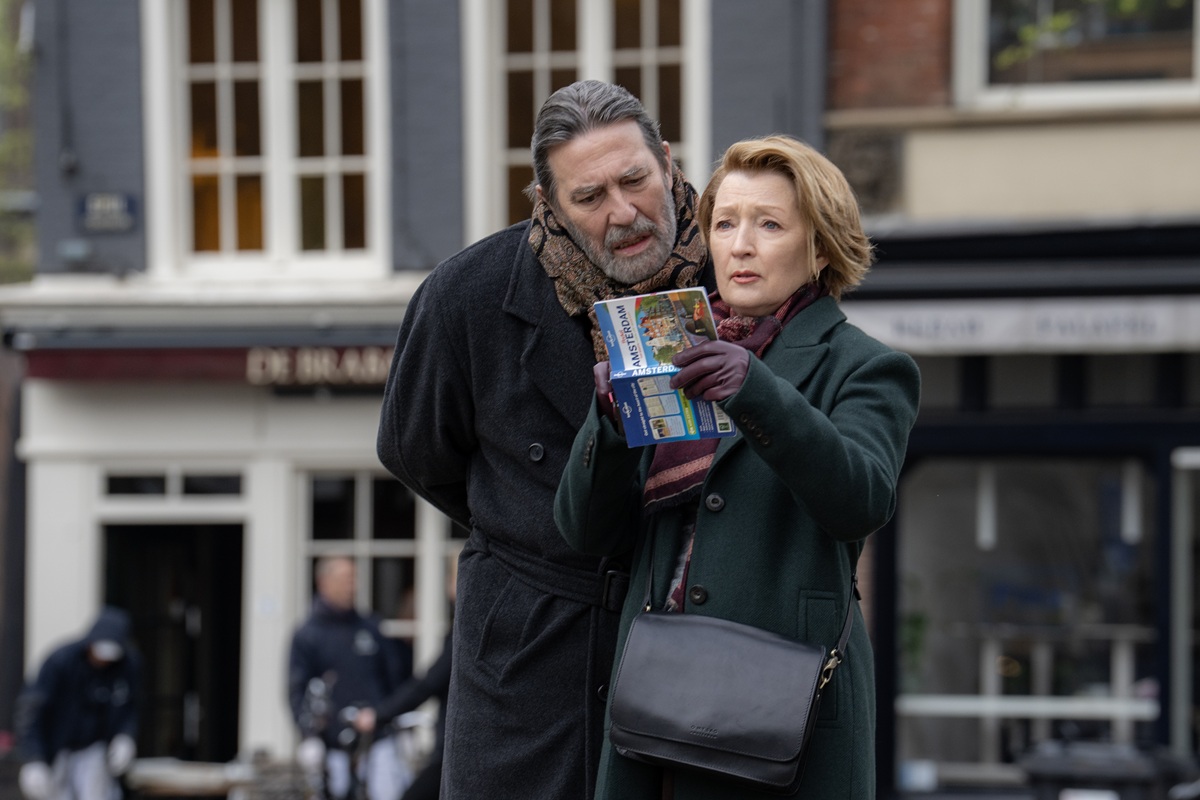
Despite the growing pressures brought on by these secular and spiritual challenges, though, Stella isn’t ready to throw in the towel just yet. So, to try and inject some much-needed vitality into her life and marriage, she spontaneously decides to surprise Gerry with a special Christmas gift – a trip to Amsterdam, a journey that she hopes will provide a chance for “an adventure” to help rejuvenate their sagging relationship. Gerry is thrilled by Stella’s generosity and thoughtfulness, and he eagerly looks forward to the trip. And Stella, in turn, is pleased that her gesture has made him happy. But little do they know that they’re about to embark on a journey that carries the potential to profoundly change their lives – and in decidedly unanticipated ways.
Upon their arrival in the Netherlands, it soon becomes apparent that Stella has made this trip for reasons other than a romantic getaway with her husband. In fact, it quickly and unexpectedly takes on the qualities of an impromptu pilgrimage, a spiritual odyssey of sorts that gives her a chance to address those unanswered questions that have so persistently been lingering in her mind.
In essence, Stella experiences an emerging awakening prompted by visits to two popular tourist destinations imbued with pronounced spiritual attributes. One is the Begijnhof, a centuries-old residential complex that served as a sanctuary for Catholic women in the Middle Ages where they could clandestinely practice their faith at a time when the Netherlands came under strict Calvinist rule, a place whose history symbolically mirrors Stella’s own past and holds considerable appeal for her as a spiritual seeker. Comparably profound stirrings surface a second time when Stella visits the Anne Frank House, the home where the famed Jewish diarist was hidden to escape capture by the Nazis during World War II. Both experiences leave Stella irrevocably changed.
Gerry, by contrast, has a very different reaction to visiting these sites. While he finds them modestly thought-provoking, they don’t leave the deep impact on him that they have on his wife, a reaction that Stella finds, for lack of a better term, offensive. She’s troubled that his underwhelmed responses are more evidence of his disinterest – if not his outright disdain – for matters of a spiritual nature. And it’s yet another indication of the widening gap that’s developing between her and her husband.
This schism subsequently prompts Stella and Gerry to each go off on their own to explore Amsterdam. Stella makes a return visit to the Begijnhof, a place to which she feels strongly drawn and where she engages in a deep conversation with one of the current residents, Kathy (Niamh Cusack), a kindred spirit whom she briefly met on her first visit to the site. It provides Stella with an opportunity to open up and express herself, almost as if she were unburdening herself in a confessional to a willing listener.
In the meantime, Gerry has a very different experience, quietly exploring Amsterdam’s shops and pubs. But, despite the differences in the venues he peruses, his visits to these locales provide him with an opportunity to sort out his feelings as well. And, while the way these feelings express themselves may be simple and more subdued than what Stella experiences, that doesn’t make his introspective time any less personal, meaningful and revelatory.
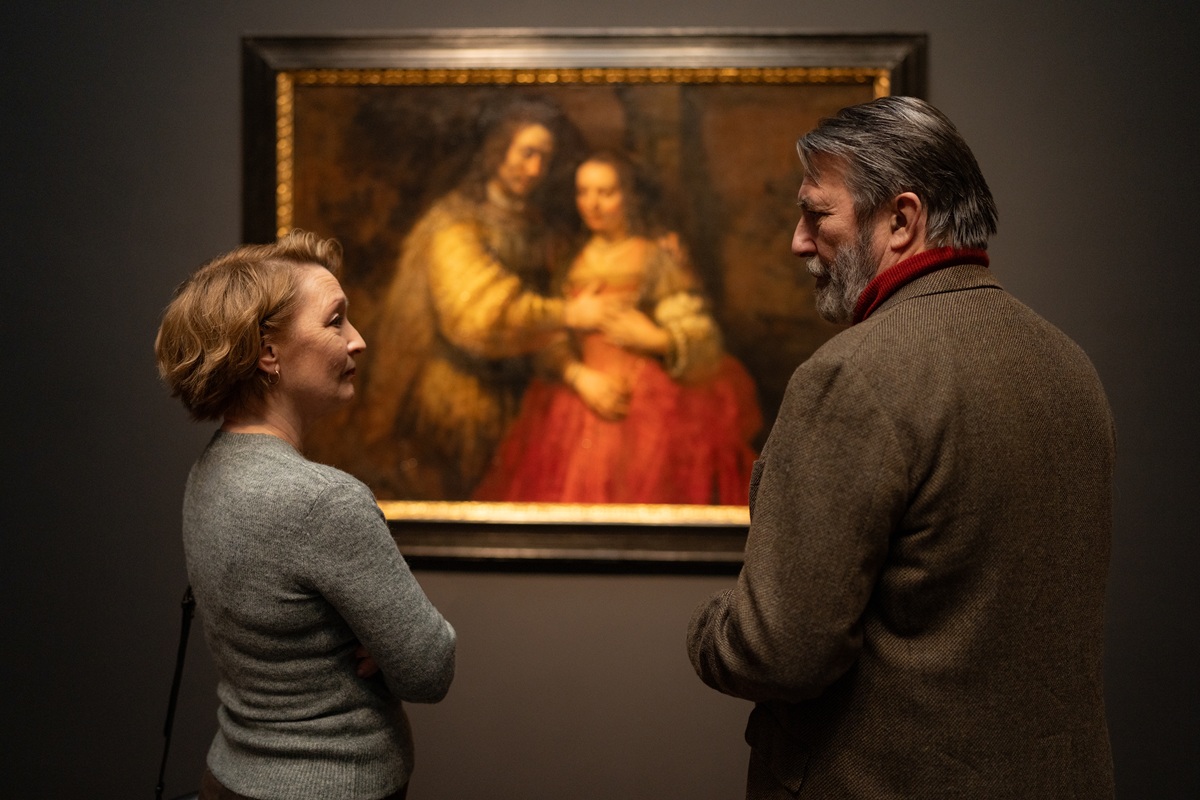
But how do Stella and Gerry ultimately each come away from their respective urban adventures? Are they closer to one another, or are they more distant than ever? Or, as unlikely as it might seem, could it be a little of both? And what will it mean for them as the end of their getaway approaches? Is this the end of their journey together, both literally and metaphorically? Or is it the turn of a page, the start of a new chapter, one with new understandings and appreciation of one another?
In essence, what ultimately happens with Stella and Gerry comes down to what they believe, a notion that carries tremendous implications not only for them, but also for all of us. That’s because of the role our beliefs play in shaping the nature of our existence, a product of the conscious creation process, the philosophy that makes such outcomes possible. It’s unclear whether either of this story’s protagonists have heard of this school of thought, but, based on how their lives are unfolding, it would appear that this knowledge would greatly help them in bringing about the kind of clarity they each want in their reality. The question, of course, is, will they avail themselves of the opportunity? To a great extent, that depends on how receptive they are to it and how they employ it if they choose to do so. And that’s important considering how much is riding on what they decide to do.
This way of thinking is especially crucial in matters of metaphysics and spirituality, for beliefs in these areas provide the fundamental underpinnings for everything that emerges out of them, from both theoretical and tangible standpoints. Given her mindset, this could (and should) be of tremendous importance to Stella, since she’s the one who’s most concerned about creating a more meaningful and fulfilling life. In fact, if there’s one spiritual truth from which she could most benefit, it would be an understanding and familiarity with this principle. But grasping that idea is clearly proving challenging considering her long-established overriding spiritual outlook.
Having lived a life as a devout religious soul, she has come to believe that the power to drive the results she seeks resides outside of herself, something that rests in purely divine hands. And while the divine spirit certainly plays a part in this process, part of it also depends on us and the intents that we put forward. Stella has definite ideas in mind for what she’s looking for, but she’s convinced that bringing them to fruition is outside her purview, that such outcomes are purely the result of divine intervention and not of a collaboratively creative process. As a consequence, she continually waits for the clouds to part for the truth to be revealed to her, unaware that she can help to facilitate that process by believing she can join in aiding the parting of those clouds. After all, this is her life that we’re talking about, not a scene out of a Cecil B. DeMille movie.
By contrast, Gerry appears to have at least an inkling of this notion, and he’s made use of it in largely practical ways to create a comfortable everyday life for himself. His wants may not be as grand as what Stella is seeking, but that doesn’t mean his results are inherently any less satisfying or meaningful. And isn’t that something most of us innately want in the end? When he learns of Stella’s lofty spiritual ambitions, Gerry tries to share his more modest insights with her, hoping that she’ll grasp them and employ them in formulating beliefs that will lead her to the attainment of sought-after fulfilling outcomes. But can she truly understand and appreciate his more down-to-earth, arguably more “mundane” approach to such matters?
Ironically, at one point during an impromptu moment of spiritual clarity while discussing the nature of miracles, Stella shares an observation with Gerry in which she maintains that these outcomes appear in all forms great and small. This is an indication that she might be on the path to understanding the foregoing notion that Gerry has been trying to impart to her ‒ and what it can do to help her achieve what she’s looking for ‒ provided she’s willing to take the advice afforded by her own insight. However, as long as she firmly holds on to the grander beliefs that she’s earnestly embraced for so many years, it’s unlikely that she’ll be able to avail herself of this simpler yet potentially more effective truth. Her own tunnel vision regarding this concept truly represents a classic case of not being able to see the forest for the trees. And that’s unfortunate, given that she may well be unwittingly cutting herself off from an abundance of genuine happiness simply by holding on to erroneously inflated notions that are fundamentally getting in her own way.
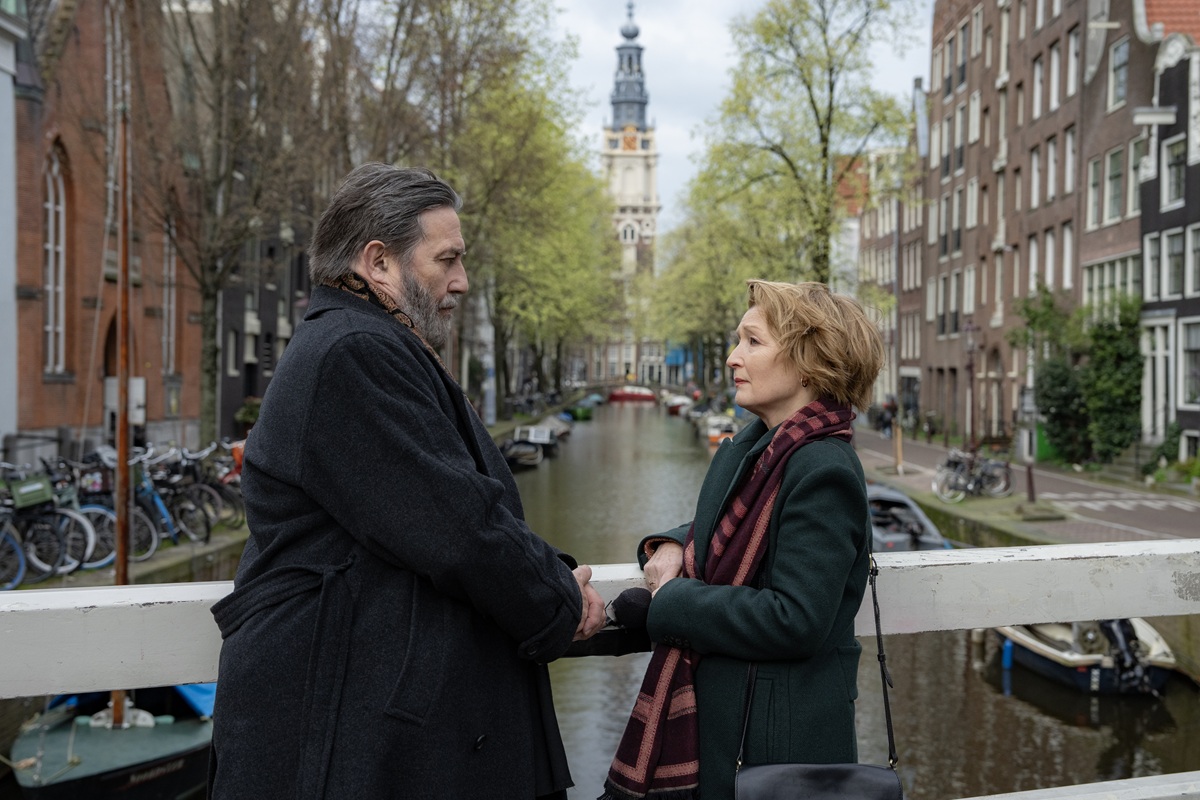
Given that we reside in a physical form of existence, the tangibility of everyday life is just as crucial to our ultimate enjoyment of it as our understanding of the supposedly loftier intangible concepts underlying it. And, in this regard, the beliefs associated with our avowed hopes and expectations about it (and how they come about) play a central role in their materialization. Do we believe that our happiness and well-being are tied to witnessing phenomena like burning bush moments, or can we find genuine contentment and fulfillment in those quiet moments of self-directed solitude and simple pleasures? Stella seems to be looking for the former, while Gerry has embraced the latter. He seems satisfied with what he’s drawn into his life, while Stella remains caught up in the incessant pursuit of something more elusive, leading to ongoing frustration – and even disillusionment ‒ when results evade her and revelations emerge that burst her bubbles.
In the end, if we’re to truly enjoy this experience we call existence, it’s imperative that we recognize that everything about it is fundamentally divine in nature and that the ways in which we employ our beliefs and focus to explore that reality ultimately determine what we get out of it, no matter how simple or complex our expectations might be. While Stella may find fulfillment by chasing spirits of an intangible nature, Gerry is just as content to look for them in liquid form at the bottom of a whiskey bottle, yet both of their respective pursuits are equally valid in their own right, no matter how much some of us might believe otherwise. The key question here, of course, is, are we getting out of these experiences what we hope to? If we’re clear about this fundamental underlying objective, we just might attain a greater sense of happiness and joy from this experience than spending our time tracking down enigmatic phantoms that forever remain beyond our grasp – and that detract from what we might otherwise realize. Given that, then, we should all be prepared to ask ourselves, are our hopes and wishes being fulfilled, and do they live up to our expectations? We can only hope the answer is yes.
The journey depicted in this story operates on both literal and metaphorical levels. The couple’s trip gives them pause to evaluate what they want out of life both individually and collectively in terms of evaluating what may lie ahead for them. It also enables them to explore deep questions about the nature and quality of their partnership, reconciling feelings about ghosts from their past, examining personal lifestyle choices, and taking stock of “big picture” perspectives on life and their respective places in the Universe. In turn, this inadvertent soul-searching exercise unearths some surprising revelations, especially when it comes to long-cherished notions about their individual belief systems. Indeed, who would have thought that a simple long weekend getaway could raise so many issues with such pervasively profound implications? Nevertheless, such are the circumstances that the protagonists find themselves in, leaving them to wonder whether they’ll be able to withstand their challenges and stay together or find themselves irrevocably changed and on new paths of self-discovery.
To these ends, director Polly Findlay’s latest offering, currently playing theatrically, truly delivers when it comes to the aforementioned contemplative narrative, providing viewers with much to think about. In doing so, “Midwinter Break” employs a deftly constructed storytelling approach in addressing its core questions, one that’s layered, nuanced and eminently thoughtful on many levels. However, it’s the kind of picture that requires close, careful, engaged viewing; without that, audience members – like the protagonists themselves – might easily miss out on the key points the picture seeks to impart. These insights emerge through the film’s carefully crafted writing and the superb performances of the two leads, both of whom are clearly at the top of their game here. It’s also a gorgeous cinematic showcase for the picturesque city that serves as the story’s backdrop but without turning into a veiled travelogue. Admittedly, there are some pacing issues early on and some occasionally awkward sequences that come across as overly “mechanical” (again at the outset) as the film seeks to find a firm footing for itself. But one could argue that these shortcomings are reflective of the puzzling and unanticipated introspective process into which the principals are about to enter. Still, those looking to be fed by this release’s ample, meaningful subject matter will likely find themselves nicely satisfied by film’s end. This offering makes for perfect midwinter viewing, a picture that has come along at just the right time to nicely facilitate our own much-needed, restorative midwinter breaks, regardless of whether we’re talking in literal or metaphorical terms. And who knows what we might take away from the experience? It could prove life-changing – or not – depending on what we each need to get out of it ‒ much like life itself.
Copyright © 2026, by Brent Marchant. All rights reserved.