



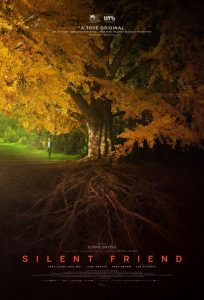
“Silent Friend” (“Stille Freundin”)
(Germany/Hungary/France/China)
Metacritic (5/10), Letterboxd (2.5/5), Imdb.com (5/10), TMDB.com (5/10), Imdb critics review
#BrentMarchant #SilentFriend #ginkgotree #botanicalresearcher #botanicalgarden #interspeciescommunication #Germany #Marburg #COVID19 #IldikóEnyedi #TonyLeung #LéaSeydoux #botanist #Kogonada #Columbus #AfterYang #arthousefilm
To me, fewer cinematic experiences are more frustrating (perhaps infuriating) than wasting time on allegedly acclaimed arthouse films whose narratives are based on contrived, pretentious, underdeveloped material. In fact, it’s one of the reasons I’m convinced (and legitimately so) that many moviegoers eschew these releases. Indeed, nothing’s worse than this when it comes to giving the genre an often-dubious reputation in the minds of theater patrons. And that’s why I’m unable to recommend this latest offering from writer-director Ildikó Enyedi. The film tells three stories loosely (and I mean very loosely) connected to one another by a common element: the comfort and companionship afforded to the protagonists by the presence of a century-old specimen Ginkgo biloba tree in the botanical garden on the campus of Germany’s Marburg University, an institution widely known for its research facilities (talk about a compelling premise). The first, set in 1908 and shot in black and white, follows the challenging experiences of Grete (Luna Wedler) as the first woman accepted as a student, a radical notion at the time. The second, set in the turbulent on-campus times of 1972, explores the on-again/off-again flirtation/friendship between Hannes (Enzo Brumm), a farm boy who’s grown tired of tending to the constant care required by plants, and Gundula (Marlene Burow), his housemate and a botanical researcher trying to “understand” how plants respond to humans in the same way that we respond to them, a quest to essentially determine whether talking to our chlorophyll-based buddies makes any difference in their well-being and their relationship with us through documented interspecies communication practices. And the third, set during the COVID-19 pandemic of 2020, chronicles the experiences of visiting Chinese neurology professor Dr. Tony Wong (Tony Leung Chiu-wai) who becomes trapped on campus, virtually alone except for the presence of resident custodian Anton (Sylvester Groth), who’s skeptical about a quasi-neurologically-related study that Tony has begun conducting on his prize ginkgo, aided virtually by French botanist Dr. Alice Sauvage (Léa Seydoux). In telling these three stories, the film appears to be leading up to some grand, unified, philosophically poetic revelation, but, unfortunately, it never materializes. Instead, viewers are left with a haphazard collection of modest insights that bear little relation to one another or to the greater state of the human condition, prompting one to ultimately heave a big, well-deserved “So what?” Admittedly, “Silent Friend” is gorgeously filmed, featuring some of the best cinematography I’ve ever seen. It’s also atmospherically constructed that recalls the works of filmmaker Kogonada (especially “Columbus” (2017) and “After Yang” (2021). But, unlike those fine releases, this offering may have matched them for aesthetics but certainly not for substance, the source of this effort’s downfall. Perhaps this production may have fared better if it had focused on only one of the story threads (in my opinion, the 2020 sequence, given that its two predecessors add previous little to the picture), but that would have required some considerable retooling to make it work. It also might have fared better if the plot had symbolically incorporated more of the widely known attributes associated with ginkgoes (a unique reproduction method, long life and living botanical dinosaur status, to name a few), but the screenplay virtually drops the ball on this almost completely, fascinating horticultural qualities that are largely left ignored. Because of all this, I’m at a loss to understand why so much praise has been heaped on this effort (especially in terms of film festival honors), save for its photography and ambiance. Maybe I’m missing something, but, as someone who has been a longtime cinephile and a seasoned journalist with years of specialized experience related to botanical matters, this one was pulled up by the roots and left to get by on its own, conditions under which nothing can realistically grow and prosper.