



‘Late Fame’ seeks to rediscover one’s calling in life
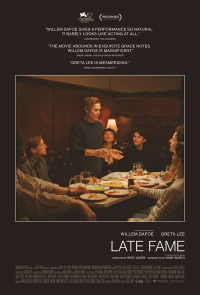
“Late Fame” (2025 production/2026 release) (USA/France). Cast: Willem Dafoe, Greta Lee, Edmund Donovan, Clay Singer, Arthur Langlie, Graham Campbell, Luca Padovan, Tony Torn, Clark Johnson, Jake Lacy. Director: Kent Jones. Screenplay: Samy Burch. Novella: Arthur Schnitzler, Late Fame (written 1894-95, published 2014). Web site. Trailer.
Well-meaning optimists often nudge us to believe that it’s never too late to discover (or rediscover) our respective callings in life (and sometimes they’re right). At a time when many of us may have given up on our dreams or settled for a less complicated way of life, there are those who may nevertheless eagerly follow such inspirational advice and find the experience refreshingly rejuvenating. But, even with the best of hopes and intentions, what’s the guarantee, if any, of success at such undertakings? Those are among the themes explored in the new dramatic character study, “Late Fame.”
In many regards, the foregoing aptly describes the life of Ed Saxberger (Willem Dafoe), a longtime postal worker nearing retirement who, at one time in his youth, was admired as a gifted aspiring poet in the 1970s New York arts scene. The 17-year-old high school dropout from western Pennsylvania moved to the Big Apple in 1979 to find his destiny and subsequently rose to prominence in a vocation that he never saw coming. But, over time, this creative venture faded, and he settled into a quiet life of relative seclusion, his published works essentially vanishing into obscurity.
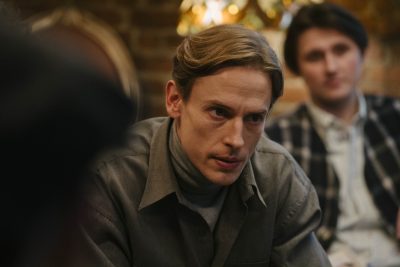
However, a chance meeting later in life holds the potential for changing everything. Fast forward to the present day, when Ed meets Meyers (Edmund Donovan), a fawning twenty-something fan of Saxberger’s now-virtually unknown works. Meyers acts as the de facto head of a creative circle of socially and financially privileged peers who regularly meet at an edgy downtown Manhattan coffeehouse. Like Meyers, the group’s other members mostly refer to themselves by their last names, including Broussard (Clay Singer), Carmichael (Arthur Langlie), Sherfey (Graham Campbell) and Winn (Luca Padovan), among others. These self-proclaimed seekers of artistic integrity and ardent foes of society’s addiction to brain-rotting technology see themselves as radical, if not uncompromising activists for their cause. They’re harsh critics of those who aren’t as obsessively committed to their respective crafts as they are, particularly the many self-anointed social media influencers and cluelessly oblivious posers who surround them, individuals whom they see as pale echoes of artists of years gone by.
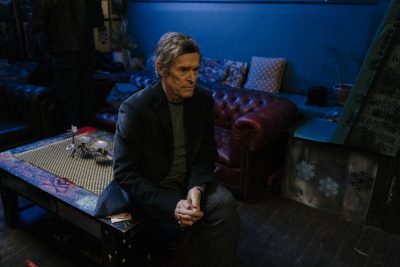
In many of the group’s gatherings, Meyers has extensively talked up his idol’s rediscovered works to his rapt colleagues, and, because of his advocacy for Saxberger’s writings, he pleads with Ed to meet them at one of their sessions. Saxberger is initially reluctant, humbly confessing that his poetic phase was a long time ago, almost in another lifetime. But, thanks to Meyers’ aggressive coaxing, he begrudgingly agrees to the invitation.
Saxberger quickly finds that these surprisingly zealous disciples want to do whatever they can to resurrect his career, a proposal that leaves him simultaneously overwhelmed but seduced. They discuss introducing him to an agent (Jake Lacy) and setting up a reading for poets, authors and performance artists like those that were common back in the day when Ed was actively pursuing his calling. They even ask him if he would consider writing and reading a new work at the event, a challenge he finds daunting but intriguing. And, consequently, the seduction is so strong that he can’t help but agree.
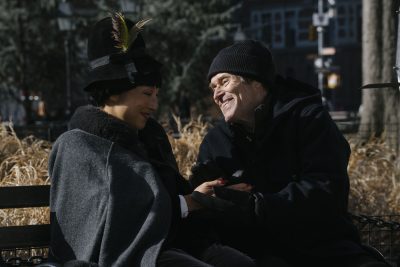
As he begins work on the new piece, Saxberger soon finds himself ensconced in a different kind of seduction as well – the advances of another group member, Gloria (Greta Lee). As the somewhat mysterious nonconformist of the group, unlike her peers, she’s one member who doesn’t follow suit and go by her last name. This middle-aged, flirtatious actress-chanteuse less than subtly makes eyes for Ed, not unlike what she’s supposedly already done for a number of other circle members. Saxberger clearly goes for this kind of attention, too, something that he apparently has not experienced for some time.
But is Ed ready for all of this newfound adoration? Can he really recapture his past? Is he up to the task and what comes with it? And are Meyers and company everything they appear to be? Those are the challenges put to the protagonist to sort out as he enters this unexpected phase of his life.
Those who have been out of circulation for a while may well jump at the chance for what’s being offered them under circumstances like these. While it’s true that they might have skeptically looked upon a comeback as a long shot after many years, that’s not to say it’s out of the realm of possibility, especially if conditions seem legitimate to make it happen. The key question that arises at this point, then, is, what does one believe? That’s crucial considering the role that our beliefs play in the manifestation of our existence, a product of the conscious creation process, the philosophy that makes such outcomes possible. It’s unclear whether Saxberger has ever heard of this school of thought, but, given his track record, he has demonstrated to himself and others that he can employ its principles to make things happen that he didn’t at one time expect. Given that, is it unrealistic to consider its recurrence? Indeed, if this were a case of something walking like a duck and talking like a duck, what would you do? And, in light of that, is there any obvious reason why Ed should do any differently? He seems convinced that proceeding along such a course is indeed valid (its unexpected qualities notwithstanding), so why shouldn’t he do so?
In pursuing such a course, however, it’s imperative that one is convinced and committed to it. Ed certainly possessed those qualities during his initial foray into writing poetry, but does he now? After all, when he first meets Meyers, he acknowledges that his poetry days were a long time ago. Some might see this as a confession that he no longer has the skills or that new or returning ventures like this are no longer possible with the onset of age. At the same time, though, this could also be an offhand acknowledgment of simply being rusty or out of practice. In either case, however, the underlying determiner is Ed’s beliefs about this prospect. And that, of course, will be determined by whatever selection of beliefs he chooses to embrace.
In deciding which beliefs to grasp, it’s important to look at those that can undercut one’s intentions. Generally speaking, fear, doubt and contradiction are those that can cause the greatest concern. The reason is that they can negate whatever other beliefs one might hold, keeping manifestations from materializing when expected or at all. These undermining beliefs, in turn, can also take on lives of their own if they’re allowed to get a foothold in our consciousness, snowballing into unstoppable juggernauts that can lead to frustration and failure, no matter what other positive conditions might be present. And eliminating them – even over the long run – may be nearly impossible.
It’s important to be realistic about the chances of success in scenarios like this, which, of course, means being honest and authentic with oneself. On the one hand, it’s possible that one might decide that there’s more to be said and done with the time one has left. On the other hand, though, such a bold undertaking as this might not be seen as worth pursuing, that it represents a part of one’s life that’s no longer relevant or that could require more effort than what one would be willing or able to expend. No matter what the decision, these are all scenarios that ultimately are driven by the beliefs that underlie them, and only we can decide which choices are best for us.
There’s also the impact of outside considerations to be taken into account. In this instance, is Ed moving ahead with his plan because it’s what he wants or what others want? Given Meyers’ gushing fan worship, it may be difficult for Saxberger to say no – another belief – or he might actually believe in his own self-worth and want to give himself another shot at the brass ring. Either way, this again brings up the question of being realistic, which, once more, only Ed can decide.
In some ways, this might sound like an exercise in overcoming ambiguity: On the one hand, an opportunity may seem like a good fit, while, on the other, it may not. And, to be honest, there likely are no definitive, universally true answers in a situation like this. Which is where the impact of our beliefs takes on even more importance in determining which decision to make. Let’s hope that Ed – and all of us – have the wisdom to see what course is best.
Based on the posthumously published novella of the same name by Austrian author Arthur Schnitzler (1862-1931), director Kent Jones’s contemporary version of this engaging character study examines the questions of can we get back what we think we’ve lost (i.e., so-called “late fame”) and what would we do with that recognition if it happens, especially if we’ve fundamentally changed in the interim. In answering these queries, the film explores an array of themes relevant to today’s conditions in the arts, in matters of legitimate integrity and authenticity, and in our willingness to embrace modern sensibilities and tangible trappings like ubiquitous technology. These rhetorical musings are effectively brought to life through the superb performances of the excellent ensemble (particularly Dafoe and Lee), the picture’s superb writing, its brisk, economical, no-nonsense pacing, and a fearless attitude in speaking its mind (an attitude not unexpected from a work by executive producer Martin Scorsese). While this offering could use a little more development in its back story, that only adds to the intrigue surrounding the protagonist’s mysterious background and unobtrusive disappearance, a minor shortcoming that’s easy to overlook.
“Late Fame” is a delicious indie surprise hitting theaters at a time of year when such releases are largely unexpected, eloquently addressing much more than what most late summer offerings typically do. Perhaps that’s because this is a story to which I could personally relate in many ways. As a writer who rediscovered his own calling late in life, this title profoundly spoke to me, something that might not strike as many familiar chords with other viewers as it did for me. But, when it comes to tales of attempted comebacks, this is one of the best I’ve ever seen. And, in that sense, maybe it will have the same effect on you, even providing enough inspiration to prompt you to put down the cell phone and get up out of the easy chair while there’s still time enough left to do something truly fulfilling with your life, late fame notwithstanding.
Copyright © 2026, by Brent Marchant. All rights reserved.