



‘Fatherland’ wrestles with the pain of dashed dreams
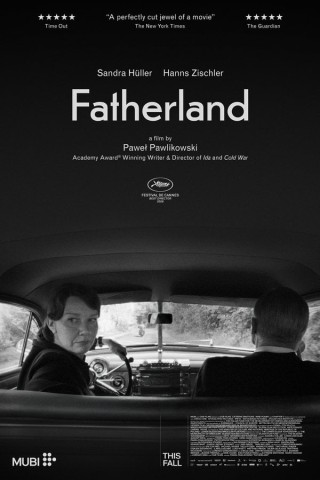
“Fatherland” (“Ojczyznz”) (2026) (Poland/Germany/Italy/France). Cast: Sandra Hüller, Hanns Zischler, August Diehl, Daniel Wagner, Devid Striesow, Anna Madeley, David Menkin, Joachim Meyerhoff, Enno Trebs, Theo Trebs, Waldemar Kobus, Joanna Kulig. Director: Pawel Pawlikowski. Screenplay: Pawel Pawlikowski and Henk Handloegten. Web site. Trailer.
Imagine the disillusionment of being honored for your accomplishments only to find out that those accolades are intrinsically insincere, an attempt to tap into your public recognition as a means to win over your tacit support in a battle of wills between two powerful forces. Are your achievements being praised for their merits, or are they being exploited simply to help fulfill another’s agenda? And would you rightly feel that your reputation had somehow been cheapened or tarnished in the process? If you can appreciate the sadness, frustration and disappointment such circumstances would engender, then you should be able to appreciate the feelings they evoked in an acclaimed novelist upon what was supposed to be his triumphant return home to his native Germany at the end of World War II, the focus of the new biographical drama, “Fatherland” (“Ojczyznz”).
In 1949, 16 years after fleeing his homeland with the rise of fascism, accomplished author Thomas Mann (1875-1955) (Hanns Zischler) returned to his roots as part of the 200th birthday celebration of Johann Wolfgang von Goethe (1749-1832), considered by many to be Germany’s most influential author. Goethe believed, as did Mann in his footsteps, in the transcendent nature of Germanic culture, a notion that arose at a time when the future-unified nation was still fractured into an array of small independent states. Mann adhered dearly to Goethe’s vision, a concept he believed to be critical after the war, when Germany was carved in two – West Germany, under the control of the US, Britain and France, and East Germany, under the control of the Soviet Union. This division thus placed “the new Germany” at the forefront of the emerging Cold War, a political and ideological battle for the hearts and minds of two opposing viewpoints, the democracy of the West and the Communism of the East. This separation troubled Mann greatly, and he hoped to fly above it, focusing on the poetic eloquence that Goethe espoused. But, as became quickly apparent, that would be easier said than done.
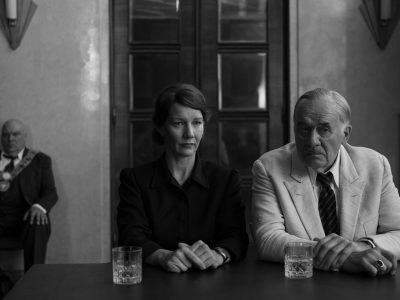
Mann, who had been living in the US for years, was scheduled to make two stops on his trip, one in Frankfurt am Main in the West, Goethe’s birthplace, and one in Weimar in the East, where he spent much of his life. He was slated to make a speech at each stop, where the American and Soviet ruling forces sought to play off his distinguished reputation in courting his support for their respective visions of the new Germany, a prospect that flew in the face of Mann’s hope for a transcendently unified nation. In fact, as one of Mann’s hosts cynically put it upon his arrival in Frankfurt, he was now being backed into a corner of having to choose between “Mickey Mouse or Stalin.”
To complicate matters, while attending a reception on his trip’s first stop, Mann was approached by Wieland and Wolfgang Wagner (Enno Trebs, Theo Trebs, respectively), the grandsons of composer Richard Wagner (1813-1883), a cherished favorite of Nazi Chancellor Adolf Hitler, who drew upon the composer’s works as a source of inspiration for his vision of the Fatherland. The younger Wagners were eager to court Mann to support the restoration of a revisionist vision for Germany, one rooted in the country’s recent prewar past and influenced by their grandfather’s music. In doing so, they also politely reminded Mann that his early literary works were said to be inspired by their grandfather’s repertoire. Mann, in turn, didn’t hesitate to remind the brothers of what the Third Reich did in appropriating their relative’s works – and that he had no love for how his music had come to be regarded or to offer any support for a return to the extremist views with which it had become associated.
Accompanying Mann on his trip was his daughter and aide, Erika (Sandra Hüller), who diligently looked after her father’s professional and personal needs. This was not an easy task given his advanced age, the pain of a recent tragedy involving his son, Klaus (August Diehl), and the pressures being put upon him to make him a pawn in this high-stakes geopolitical game. He believed that he could fly above these ordeals by taking the high road intellectually and practically, but he was in denial of the agony of the losses involved and how he was being manipulated by others (some of whom were quietly and innately opposed to Mann and his sometimes-unpopular sentiments), truths to which Erika desperately tried to enlighten him. Their trip together, then, was one of reconciliation and acceptance of these conditions. But, considering the stakes involved professionally and personally, would Mann be up to the challenges they posed?
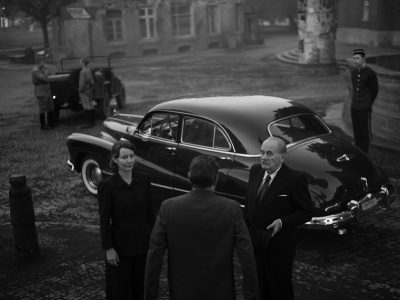
After leaving Frankfurt, Mann and his daughter traveled to Germany’s Eastern Sector for their stop in Weimar. But, as happened in Frankfurt, they were again subjected to the same kind of genial arm-twisting that they experienced in the west, most notably by Eastern Bloc officials Major General Sergei Ivanovich Tulpanov (Daniel Wagner) and Johannes Becher (Devid Striesow). And, sadly, by this point, Mann’s disillusionment began to set in, seeing his worst fears confirmed and his hopes for the new Germany in Goethe’s image being dashed before his eyes.
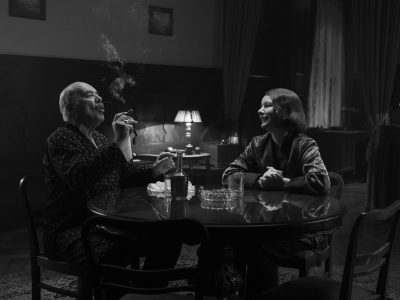
Based on the foregoing, Thomas Mann was in a decidedly unenviable position. Being caught between two powerful ideological perspectives (three if one counts the viewpoint of the Wagner brothers), he was being pulled in opposite directions as he watched his own dream for the future of a new Germany vanishing before him. One might think he didn’t know what to believe given these strong-arm tactics, but he actually had a clear vision for, and strong belief in, what he wanted, no matter how roundly it was disappearing. And, to his credit, that’s crucial in light of the role that our beliefs play in the manifestation of our existence (especially in its preferred form), thanks to the conscious creation process, the philosophy that makes such outcomes possible. It’s unclear whether he had ever heard of this school of thought, but, given the strength of his convictions, he clearly knew what he wanted, despite the pressure being put upon him by outside sources. The question here, of course, was, could it indeed be brought into reality?
As one watches this film, however, there’s a pervasive sadness to its narrative. In 1949, there should have been cause for hopefulness, optimism and celebration, a time when the war was finally over and the rebuilding process was under way. Yet those considerations were ultimately secondary, giving way to the agendas of the “victors” in the conflict, namely, who would get the bigger foothold in Europe, particularly in Germany. In many regards, those adhering to that belief ran roughshod over enlightened thinkers like Mann, who saw these circumstances as being an opportunity to launch a new Germanic renaissance, one rooted in its rich cultural and artistic traditions, the kind of society that Goethe envisioned but that was politely seen as superfluous by policy makers.
As time passed, though, Mann could see that his disillusionment was getting the better of him, and his beliefs behind his vision weren’t strong enough to overcome the opposition. His supposedly triumphant return home after so many years away was turning to sorrow, and there was little he could do to stop it. While it’s true that a unified Germany would once again reappear many years later, it still wasn’t (and isn’t) the nation he sought to bring into being. Old grudges and disagreements remained – some of which were spawned in the post-war era – even when the country was later reunited under a single flag.
“Fatherland” thus presents viewers with a reality check when it comes to our beliefs and how they’re deployed to produce the outcomes we seek. It can be quite a trying exercise, as this picture so aptly illustrates. And it makes one wonder whether anything can realistically be done when events don’t materialize as planned.
Guarantees under conditions like this may be formidable, if not impossible, to secure. But this doesn’t mean one should give up the ship. As recent experiences have shown us, fundamental change is possible with sufficient belief support behind it. It also means not giving in to undercutting beliefs like fear, doubt and contradiction, notions that are sure to lead to failure and disappointment. Dreams may be dashed in the short term, but that doesn’t mean the change must be permanent. Remember, when Pandora’s box was opened and all of the furies escaped, there was also one that remained after their departure – hope. That might not be a lot to hold onto, but it’s better than nothing, especially when it works its magic in bringing visionary ideas into existence.
This fact-based version of Mann’s odyssey is a quietly moving exploration of how to reconcile one’s feelings and beliefs about circumstances over which one has little control, to earnestly (albeit painstakingly) try to fly above the fray when persistently being tugged at from forces below. Admittedly, there’s an innate sorrow hanging over the duo’s journey, one associated with feelings of loss over what’s gone and never likely to return. The regrets stemming from this almost made Mann and his daughter wonder whether ending the conflict only created new and potentially bigger problems to be solved – and with all of this coming on top of personal anguish as well. While the film probably could have used a little more back story to supplement its scant 1:22:00 runtime and to enlighten viewers unfamiliar with the material, “Fatherland” is otherwise one of this year’s best releases, featuring outstanding performances by Zischler and Hüller, as well as its gorgeous and fittingly metaphorical black-and-white cinematography, one of the filmmaker’s signature aesthetic hallmarks. For its efforts, the picture earned two nominations at the 2026 Cannes Film Festival, including a win for Pawel Pawlikowski as best director, with more awards season accolades likely to come – and deservedly so. The film is currently playing theatrically.
Disappointment is one of those emotions that’s difficult to process. It’s a setback from which it can be hard to rebound. But, like failure, it can also be a valuable teacher, showing us where things went awry and, possibly, how to bounce back. It also enables us to give ourselves permission to grieve when plans don’t work out, a necessary element to eliminate if we ever hope to make a comeback. This is one of those situations where we should be thankful for what we learn from the experience so that we don’t make the same mistakes when starting over. And that’s essential if we ever hope to see our dreams realized rather than dashed.
Copyright © 2026, by Brent Marchant. All rights reserved.