



‘Disclosure Day’ delivers revelations on multiple levels
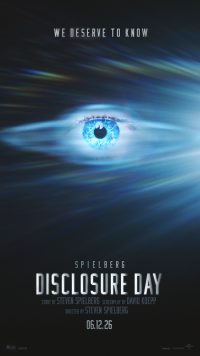
“Disclosure Day” (2026) (USA). Cast: Emily Blunt, Josh O’Connor, Colin Firth, Eve Hewson, Colman Domingo, Wyatt Russell, Henry Lloyd-Hughes, Elizabeth Marvel, Tommy Martinez, Jeremy Shamos, Eboni Booth, Tyler Maxwell Renaud, Delaney Anne Cuthbert. Director: Steven Spielberg. Screenplay: David Koepp. Story: Steven Spielberg. Web site. Trailer.
“Disclosure” can be an awfully loaded word, one that carries connotations on multiple levels, both big and small, but nearly always with personally meaningful ramifications. However, sometimes those implications may be so subtle that they’re not easy to spot, grasp or understand, even though that does not diminish their importance. It’s also interesting to note how they’re frequently revealed simultaneously, heightening their impact, especially if they’re considered in tandem with one another, a circumstance that may be hard to ignore. Such are the dynamics at work in the latest offering from iconic filmmaker Steven Spielberg, “Disclosure Day,” handily the director’s best picture in years.
This sci-fi/conspiracy theory/personal discovery thriller sports a multifaceted narrative that might be seen as too complex to detail without running the risk of disclosing an array of spoilers, a practice I endeavor to avoid as much as possible in my writings. But that lack of foreknowledge is likely to be beneficial to viewers who walk into the theater knowing little, if anything, about the film in advance. In fact, I’d actually recommend approaching this offering from that standpoint to allow it to wash over viewers organically, enabling an experience where one can wrap oneself up in the sense of awe and wonder it evokes without the hindrance of too many preconceptions. To be perfectly honest, it’s virtually impossible to conceal the fact that the film deals with exposing the longstanding UFO and extraterrestrial presence coverups that are believed to have been ongoing for nearly 80 years. But, in all truthfulness, it’s more – much, much more – than that. That’s particularly true with regard to the fundamental approach it uses to examine the subject of disclosures – revelations of many kinds, including those of a highly personal and spiritual nature. This combination of elements thus adds depth to what might have otherwise been merely a conventional and monodimensional work of science fiction, thereby imbuing the picture’s content – and even its very title – with multiple meanings on myriad levels. Indeed, it’s not just another movie about space aliens.
The aforementioned disclosures emerge from the film’s myriad story threads, which start out seemingly disparate and unrelated, much like the storytelling approach the filmmaker used at the outset of his earlier work, “Close Encounters of the Third Kind” (1977). But, as this picture unfolds, connections develop among this film’s various story arcs, showing how they all ultimately converge and coalesce, just like they ultimately did in its predecessor picture. Viewers should note, however, that, despite the similarity in storytelling methodology employed here, that’s where the resemblance ends. This is a different story, with different characters, different themes, different events and different messages, that just happens to present them following a familiar formula (and one that works here as well as before). In that sense, then, audience members shouldn’t think of this an updated remake or even a sequel but more as a continuation of the subject matter’s mythology, only this time with additional elements that bring the story down to a more personal level, an intimacy that could be seen as being a little closer to home.
Without giving away too much, the principal story threads that run through the picture include the following:
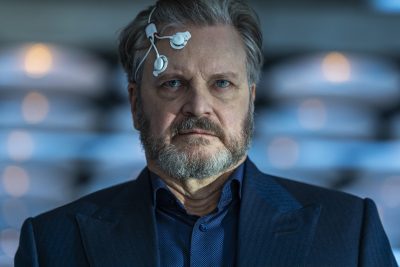
- To help government authorities deflect attention away from themselves regarding the UFO/extraterrestrial question, they outsource many of the resources associated with it to the super-secret Wardex Corp. The contractor helps to conceal these assets and back-engineer alien technology for developing new weapons, prototype aircraft and other dubious devices. Heading Wardex’s operations is Noah Scanlon (Colin Firth), a cut-throat corporate shark who brings new meaning to the word “villain.”
- Given the nature of Wardex’s operations through the years, a number of high-ranking employees have grown discontent with its coverup tactics. They believe the public deserves the right to know the truth about what’s going on under the radar. They’ve thus clandestinely united to become whistleblowers under the direction of Dr. Daniel Kellner (Josh O’Connor) and Hugo Wakefield (Colman Domingo), an initiative hounded by dogged surveillance and plagued by ever-growing peril.
- After considerable soul-searching, monastic novice Jane Blankenship (Eve Hewson) abandons her once-devoted calling to pursue answers to profound questions that religion wasn’t providing her. She still consults a former convent colleague, Sister Maura (Elizabeth Marvel), for guidance, but she also branches out to explore new relationships with others, one of whom just happens to be Dr. Daniel Kellner. Little does she know what she’s getting herself into.
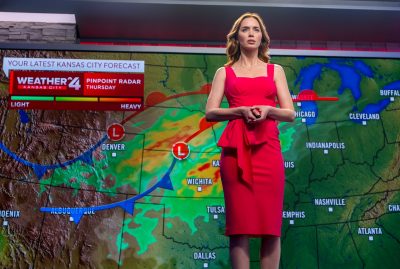
- Kansas City TV weather girl Margaret Fairchild (Emily Blunt) has achieved a certain level of notoriety in her work, but she’s restless and unsatisfied, desperately seeking to discover where she truly belongs. She thinks this may involve getting a job in another city, but being “where she’s supposed to be” may involve something more profound, an endeavor that her live-in boyfriend, Jackson (Wyatt Russell) doesn’t understand. She’s also troubled by unsettling ghosts of her past that have dogged her for years. But all of that is nothing compared to what transpires when she spontaneously begins developing inexplicable abilities, such as psychic skills, a capacity for foreign languages she never spoke before, assorted visions and rash urges to pursue intuitive impulses that appear to defy logic. And, when she’s at the center of a bizarre on-air incident, all bets are off.
- And, as all of these other story threads unfold, the world at large appears to be approaching the brink of war. The escalation of global tensions seems to have everyone on edge. Will this spill over into the outbreak of open hostility?
Needless to say, there’s a lot behind the conundrums posed by these various scenarios, situations ripe for the disclosure of hidden secrets on multiple levels, both big and small. They each carry significant consequences in themselves, so one can only imagine what will happen when they all come together simultaneously. That combination carries the potential for completely changing the worlds of these individuals, not to mention for the rest of us.
The power of disclosure can change the world drastically in many ways. That’s because such revelations contain information that can alter our thinking, views and perceptions – essential elements that go into the formation of our beliefs. And that’s crucial to recognize given the power of our beliefs to shape the nature of our reality, an outcome made possible by the conscious creation process, the philosophy that dictates the nature of such outcomes. It’s unclear whether any of these characters have ever heard of this school of thought, but, considering what’s at stake here – and how drastically conditions may become reshaped by such disclosures – it’s hard to fathom that they could ignore it once sweeping changes start falling into place. What will they do then? Can they keep up? And what would we do if faced with comparable circumstances?
Imagine what it would be like to wake up one morning and find out that disclosure of the kind sought by the whistleblowers in this film had come to pass in our own world. How would such news make you feel? What would it now prompt you to believe and, by extension, how it would affect the character of your world and the nature of your existence? It’s probably a pretty safe bet that it would be significantly different, forever changed from what came before. The impact might not be noticed immediately, but it would certainly launch us on a new trajectory that would affect virtually all of our thoughts and what emerges from them. And, if that doesn’t reflect the power of what disclosure can do, I don’t know what will.
The most apparent changes would likely be those of a tangible nature – new technologies, the appearance of new beings, and whatever physical, cultural and scientific attributes characterize them. Those changes would be hard to ignore once they appear within our reality. What’s more, our interaction with them would alter conditions further. New friendships could develop. New joint activities between us and them might arise. And travel to new worlds and perhaps new dimensions may become commonplace, resulting in new perceptions of and beliefs about our existence. Again, if that doesn’t reflect the power of what disclosure can do, I don’t know what will.
However, the magnitude of these shifts is just the beginning. Alterations to the external trappings of our existence could very well be significant, but think about what other changes they might prompt – and what will arise once disclosed. This is an important – and, sadly, frequently overlooked – aspect of this film. The changes around us could indeed be formidable, but they could easily pale in comparison to the new developments that occur within us. And, once they surface, they might blow the lid off what we believe about ourselves and our reality.

Some of us may already be sensing the emergence of circumstances like these. This becomes apparent in the film, for example, through the experiences of several characters. Margaret and Daniel, for instance, offer powerful evidence of these changes. The appearance of Margaret’s new psychic and language capabilities exemplify this clearly and play a major role in her ongoing quest to discover “where she belongs.” Her experience thus reveals that our assumed destination may not, in fact, involve a place but a mindset and a collection of skills that help to define our destiny and give our lives purpose.
Such is also the case with Daniel. His drive to expose the truth is more than just a personal obsession; it’s about his desire to bring much-needed change to a world through the exposure of long-hidden secrets that, once disclosed, have the power to revolutionize the planet. Indeed, imagine, for example, if the power of such disclosure were so great and so captivating that it could summarily trump news headlines about incidents as formidable as the possible outbreak of World War III.
In both of these cases, disclosure is brought down to a highly personal level, affecting us on an unmatched level of intimacy. Disclosure in this regard may not come across as flashy as the revelation of an extraterrestrial presence (particularly in its cinematic depiction), but its power and impact are just as great. Such cerebral changes may not seemingly be prompted directly by the alien disclosure effort, but it could serve as a pretext that incites the emergence of comparable disclosure parallels, thematically symbolic reflections of the power of what disclosure can do, even if in a different context. Beliefs change as a consequence, and those new intents may, in turn, yield a host of significant new developments.
As the film illustrates, one area in which the greatest, most intimate shifts could occur involves religion and spirituality, concepts whose very foundations are built on beliefs. It is also an aspect of life about which those in officialdom are said to have long been most concerned – that the revelation of an alien presence could lead to widespread social, civil, spiritual and scientific chaos, brought about by an awareness of something many of us would be unable to accept. Fear of a sweeping inability to reconcile established dogma with such seemingly radical notions has supposedly been the rationale behind keeping a lid on this news all these years.
But, as evidence of the alien presence has trickled out over time, views have begun to change, perhaps not in a wholesale manner but certainly not to the degree long feared. It has helped prompt a search for answers that conventional religion has been unable to provide. And the lingering doubts that have arisen as a consequence could well help to explain the change of heart experienced by individuals like Jane. She may not be locked into the ET theory as the driving force behind giving up her calling, but she’s nevertheless committed to finding the answers she seeks through different channels from which she’s accustomed. And how coincidental it is that she’s used her beliefs (even if unconsciously) to draw someone like Daniel into her life at a time like this. Imagine what additional changes in beliefs might be wrought in this regard if disclosure were to kick in.
Despite Jane’s new spiritual explorations, however, it’s curious how she also continues to tap into the wisdom of Sister Maura. It’s as if she has one foot in each camp. But that, in itself, carries implications that others may not have previously considered, namely, that it’s possible these ideas are not necessarily mutually exclusive. And this conceivably represents a new set of beliefs that weren’t previously examined. Indeed, in this case, one might even contend that disclosure could potentially work miracles.

If all of these different examples of disclosure and the beliefs they’re capable of spawning aren’t enough to convince you of the power at work here, I can’t think of what might convince you otherwise. And that goes for the power of this film, too, which, regrettably, has been unfairly criticized in many circles. Some have called this offering’s multifaceted storytelling meandering, improbable and unrealistic. But many of us have undoubtedly seen scenarios like this in our own lives, and, when that occurs, it doesn’t seem nearly so farfetched (so why should it be any different here?). To be sure, “Disclosure Day” is a complex, detailed picture that requires proper attention when screening it. It’s not a film one can glance at casually when not scrolling through the latest social media feeds on a cell phone (something that shouldn’t even be turned on in the theater to begin with). A close, committed watch will reveal much, most notably a palette of inspiring, meaningful insights. But, if you’re unable or unwilling to do this for a film with a 2:25:00 runtime, you might want to skip this one (but that would be your loss).
Director Steven Spielberg’s filmography is legendary, to say the least. Movies like “Jaws” (1975), “Close Encounters of the Third Kind” (1977), “Raiders of the Lost Ark” (1981), “E.T.: The Extraterrestrial” (1982), “Schindler’s List” (1993) and “Jurassic Park” (1993) have gone down as classics in the annals of filmmaking. And, even though some of his works in more recent years haven’t quite lived up to the quality of past efforts, it’s comforting to know that he’s still got what it takes when he gets behind the camera. This is where his latest release comes into play, easily his best picture in years.
Without a doubt, Spielberg is back at the top of his game here, telling a story with the same skill and meticulous filmmaking approach he has employed in so many other releases over the years, particularly in such areas as depicting a compelling plot, building suspense, executing gripping action sequences and providing appropriately timed comic relief. He also incorporates a comprehensive palette of ufology-related topics, some of which are well known and others of which are more obscure (references that fans of Coast to Coast AM radio and The X-Files TV series will surely appreciate), but all of which are sufficiently explained without requiring ample viewer foreknowledge. And Spielberg has a lot of help bringing all this into being thanks to the insightful screenplay of David Koepp, the original score of composer John Williams (arguably his most mature work ever), and the superb performances of Blunt, O’Connor, Firth, Domingo, Hewson, Russell and Marvel. I heartily recommend watching this on as large a screen as possible (e.g., IMAX) for maximum effect.
“Disclosure Day” is about as nearly a perfect piece of filmmaking as one can envision, so please pay no heed to the trolls voicing their uninformed opinions in trying to inexplicably tear this one down. In fact, if I had to register a complaint of any kind here, it might be that the final act could be seen as being a little stretched out, but that’s such a minor criticism that it’s hardly worth mentioning. Savor all of the various forms of disclosure being served up in this release, as you may end up drawing upon them to discover aspects about yourself that you never knew before – and enabling you to walk out of the theater at the end a different person than who you were when you went in and into a different world than what you knew before. Indeed, there’s that power of disclosure at work again.
Copyright © 2026, by Brent Marchant. All rights reserved.