



‘The End of Oak Street’ celebrates second chances
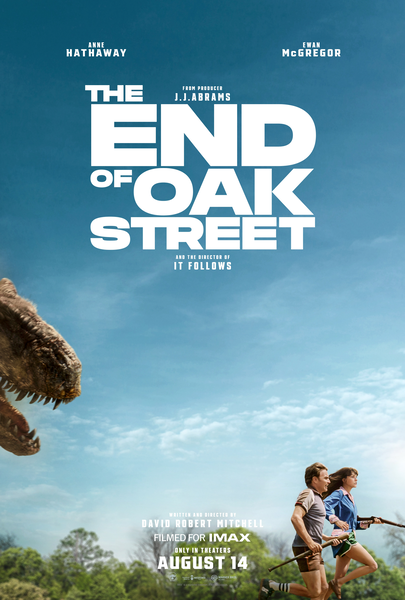
“The End of Oak Street” (USA) (2026). Cast: Anne Hathaway, Ewan McGregor, Maisy Stella, Christian Convery, Jordan Alexa Davis, P.J. Byrne, Hudson Meek, David Alexander Kaplan, Anne Gee Byrd, Emily Kuroda, Denitra Isler. Director: David Robert Mitchell. Screenplay: David Robert Mitchell. Web site. Trailer.
Movies about second chances are fairly common fare in the world of cinema. They provide opportunities to explore the value of themes like redemption and forgiveness. And these notions are usually examined within the context of interpersonal dramas or gentle comedies. So it’s truly unusual to find them as thematic underpinnings in as unlikely a context as science fiction. Nevertheless, such is the case in the new Spielbergian summertime blockbuster, “The End of Oak Street.”
It’s summer 1982 in suburban Michigan, and the Oak Street community is holding its annual block party. All the neighbors are participating in the festivities, including cookouts and fun and games for the kids. So it is for the Platt family, a prototypical nuclear family headed by mother Denise (Anne Hathaway) and father Greg (Ewan McGregor), parents of teenage children Audrey (Maisy Stella) and Brian (Christian Convery), and proud owners of a mischievous but resourceful Australian cattle dog named Starbuck. On the surface, they appear as happy and healthy a family as one might find in any Steven Spielberg movie of the era. But, beneath thus façade, there’s trouble in paradise.
For starters, Denise and Greg have been experiencing marital problems, arguing frequently about various issues involving money, the satisfaction in their relationship, dad’s inexplicable workaholic tendencies (cover for a darker secret) and Greg’s leanings toward problem drinking. Denise has even been writing a book about her situation, a thinly veiled work of fiction documenting her prevailing dissatisfaction, including her practice of keeping a suitcase packed at all times in case she feels the need to make a hasty escape. The kids experience their share of difficulties, too. Audrey is frustrated that the family can’t afford to send her to the college of her choice, Cornell, for which she has held a dream of studying astronomy and following in the footsteps of her idol, one of the university’s celebrated professors, Carl Sagan. Meanwhile, Brian is experiencing the typical world-ending adolescent trials and tribulations of confronting the neighborhood bully, Kaden (Hudson Meek), and longingly swooning over the arrival of a pretty new neighbor girl, Jeanette (Jordan Alexa Davis), who pays him no mind. And the entire Platt family has had to contend with their cantankerous next-door neighbor, Mel (P.J. Byrne), who constantly complains to them about everything, especially the rambunctious transgressions into his yard by Starbuck. But the stress of all of these issues pales in comparison to what’s about to unfold.
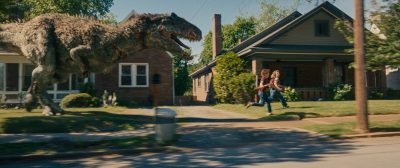
As in typical summertime action-adventure fashion, things start out slowly, such as with the sudden appearance of a mysterious, unidentified plant in the backyard. Denise consults the local librarian, Mrs. Valcourt (Emily Kuroda), for an answer, but she’s unable to help much other than to say that the specimen resembles an extinct prehistoric species. But circumstances ramp up quickly thereafter with the occurrence of bright flashes of light late at night, accompanied by strong winds, events that leave more anomalous traces of evidence that something is amiss and that knock out the functionality of all infrastructure components, like power, phone service and radio signals. However, these developments are nothing compared to what follows – the appearance of ravenous dinosaurs marauding through the neighborhood.
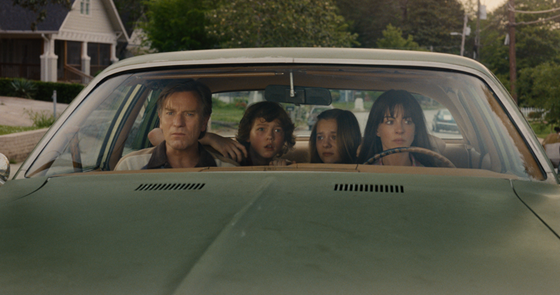
Needless to say, the family is dumbstruck by this unexpected event. But, then, who wouldn’t be? Imagine witnessing your unsuspecting neighbors being instantly and unceremoniously gobbled up by these single-minded carnivores. And, even though gas-powered vehicles still function, there’s nowhere to go, given that Oak Street is cut off from what has now become the outside world. Much to their disbelief, the Platts are trapped, unaware of how this scenario arose and what they can do to get out of it.
Considering the circumstances, survival becomes the primary priority at this point, an objective that’s more challenging than what one might expect. The family is constantly on the run, looking for ways to hide and to outwit the creatures hunting them down as food. What’s more, the usual extensions of compassion that members of a civilized society would naturally try to provide to others have become risky luxuries compared to the conditions that operated previously. Efforts to find a lost Starbuck, for example, become a matter of life and death when he escapes and runs away on one of his typical tangents. And helping Jeanette when she gets in trouble threatens her safety, as well as that of her would-be rescuers.
So is escape even possible at this point? That’s hard to say. But, when Audrey breaks down the events that led up to this situation, she proposes a theory (strange though it may be) that might explain how and why this scenario could have come about. However, is this evacuation hypothesis achievable or just wishful thinking? That’s what the Platts attempt to find out. Maybe they’ll get a second chance after all, an opportunity for escape and redemption. If they don’t succeed, though, they may ultimately be facing the end of Oak Street – and themselves.
At first glance, this situation probably seems hopelessly insurmountable. But is that really true? What if Audrey’s theory has genuine validity? Wouldn’t that provide a viable solution? In actuality, though, much would depend on the characters’ belief in the possibility to avail themselves of it. Given the nature of the solution, Audrey might be just as wrong as right. But suppose a belief in its viability is factored into the mix. Wouldn’t that increase the possibility of success? Adherents to the conscious creation process would undoubtedly agree with this philosophy, one that maintains we draw upon the power of our beliefs in creating the existence we experience. It’s unclear (though probably unlikely) that any of the Platt family members have heard of this school of thought, but, with their backs to the wall, they may have no other choice open to them under these circumstances. After all, in line with this thinking, outcomes are indeed alterable with changes in beliefs, including something as potentially suspect as the possibility that second chances are even attainable. So, in light of that, given the choices available, what would you choose?
For starters, considering the extraordinary conditions in place in this scenario, those seeking a solution would need to look to answers (and the beliefs underlying them) that are equally extraordinary. There’s an inherent risk in this, of course, that those new implementing beliefs may be so outrageous that they would be hard to believe. That’s where thinking outside the box comes into play, specifically the need to push past conventional limitations in devising intents that can be employed to achieve success. That would be a tall order, to be sure, but such innovative ideas – if employed skillfully and effectively – just might attain the sought-after outcome. Think about that the next time you’re faced with circumstances in which it would seem that there’s no way out.
Engaging in a practice like this also calls for implementing determined focus. When one’s very survival is on the line, considerations once considered important may seem trivial by comparison. Worries about money, relationship matters, college education choices and the neighborhood bully, for example, suddenly appear rather insignificant in a situation like this. This is not to suggest that they need to be scrapped entirely, but they certainly need to be set aside until more pressing matters are resolved. In essence, this is an exercise in setting priorities. When push comes to shove, it should be easy to see what matters most. Besides, the set-aside beliefs can always be returned to later – provided one manages to survive, that is.
Of course, when going through a traumatic experience like this, those set-aside considerations may not even matter much anymore once one comes out of turmoil like this. An oft-used expression maintains “Don’t sweat the small stuff – and it’s all small stuff.” Such wisdom usually makes a lot of sense to those who undergo experiences of this magnitude. And that can yield an entirely new outlook on life, a fundamental shift for the better in one’s perspective on the nature of existence. And who would think that nearly getting devoured by a dinosaur can have such existential impact?
When it comes to summertime movies, many viewers expect fun thrill rides, escapist fare at its best. At the same time, though, as the summer movie season winds down, expectations tend to lower by the time August rolls around, when the dregs of its remaining releases are unceremoniously rolled out. But, every so often, audiences are in for an unexpected nifty little treat when a sleeper offering hits theaters. Such is the case with the latest effort from writer-director David Robert Mitchell, a Spielbergian sci-fi retrothriller that skillfully drops elements of the “Jurassic Park” franchise into 1980s suburbia, and it does so with a deft mix of heart-pounding action-adventure and raucous, often-campy humor. In fact, it’s been repeatedly referred to as “the best Jurassic Park sequel never made.”
Admittedly, the premise of this story is a relatively simple one, and it occasionally turns repetitive and derivative as it plays out. However, these shortcomings are made up for by great action sequences and raucously funny laughs, many of them deliberately over the top and characterized by ample but restrained gratuitousness (though squeamish viewers may still wish to bow out). A number of typical Spielbergian tropes are also included here, and it’s gratifying to see that all of these story threads are effectively integrated into the flow of the narrative and are sufficiently wrapped up by the time the credits roll. But perhaps the biggest surprise is the film’s inclusion of subtle but effective themes one might not anticipate from a production like this, such as messages related to second chances, redemption and forgiveness, which are skillfully incorporated without beating viewers over the head (credit the expertly penned script for this).
Considering everything this release has to offer, it’s been a little disappointing to see the tepid response it has generated at the box office. Thankfully, though, while many critics acknowledge that there are numerous respectful nods to the “Jurassic” franchise, most astutely appreciate the big nostalgic fun in this, despite a cantankerously vocal minority of cynical peers who contend such attributes are out-and-out ripoffs of classic cinematic content. I suppose one could see things that way, but that spoils the fun, begging the question about the half-empty/half-full glass metaphor, one that ultimately comes down to your view/your choice. So what’s it going to be? Given the dearth of good, entertaining pictures at this time of year, in my view, “The End of Oak Street” is genuinely a welcome breath of fresh air in an otherwise-stale room, a late summer release that’s truly “dino-mite.”
Second chances may be something to which many of us give little thought until we find ourselves in a situation where we need one. “The End of Oak Street” brings that to light subtly but effectively. Indeed, when our world feels like it’s falling apart, such dire circumstances can help us put things in perspective, both in the moment and for the future. And who says we can’t learn anything from dinosaurs?
Copyright © 2026, by Brent Marchant. All rights reserved.