



‘The Marching Band’ showcases brotherly love
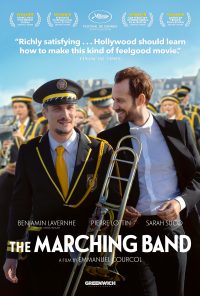
“The Marching Band” (“En Fanfare”) (2024 production/2026 release) (France). Cast: Benjamin Lavernhe, Pierre Lottin, Sarah Suco, Mathilde Courcol-Rozès, Johnny Montreuil, Clémence Massart, Ludmila Mikaël, Antonin Lartaud. Director: Emmanuel Courcol. Screenplay: Emmanuel Courcol, Irène Muscari, Oriane Bonduel, Marianne Tomersy and Khalad Amara. Web site. Trailer.
Fostering brotherly love isn’t always easy, especially when siblings are different from one another or, even more fundamentally, when they are unaware of one another’s very existence. But sometimes circumstances arise that break down these barriers and open up a new set of dynamics, providing an opportunity to put these conditions to the test to see what they might yield. Such is the case with two siblings long unknown to one another who are unexpectedly drawn together in a crisis in the heartwarming French comedy-drama, “The Marching Band” (“En Fanfare”).
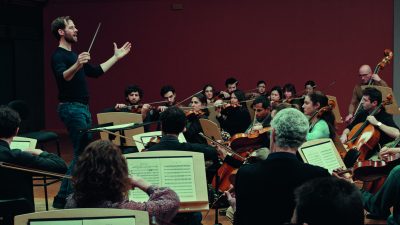
When famed orchestral conductor Thibaut Desormeaux (Benjamin Lavernhe) collapses during rehearsal, everyone is naturally concerned. After all, that’s not the sort of thing that’s supposed to happen to a seemingly healthy man in his thirties. But he soon learns that he has leukemia and requires a bone marrow transplant, a procedure in which the necessary donation material must come from someone who is a compatible match, most often a relative. Thibaut’s first choice for a donor is his sister, Rose (Mathilde Courcol-Rozès). However, when he learns the results of her screening test during a visit to his physician, he’s in for a pair of big surprises.
The first surprise is that Rose is not a match, and that’s because she is not Thibaut’s biological sibling, a fact about which he was completely unaware. It turns out that he was adopted, a secret that his mother (Ludmila Mikaël) had kept from him all these years. And, at first glance, that revelation would seemingly reduce his chances of finding a suitable donor, significantly diminishing his chances of survival.
Ironically enough, though, the first surprise leads to an even bigger second revelation: through a DNA database search, it’s found that Thibaut has a biological brother who he never knew existed. And, if a screening test proves positive, there’s hope for finding a suitable match. Of course, for that possibility to come true, he must first locate his sibling and convince him to go through a screening that might save a stranger’s life.
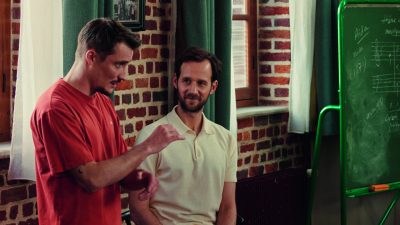
As it turns out, the long-lost mystery brother is nothing like Thibaut, as he discovers when the sophisticated Parisian pays a visit to his home in the more provincial city of Lille. Jimmy Lecocq (Pierre Lottin) is a blue collar cafeteria worker who leads a far more modest life than his renowned brother. Jimmy is naturally surprised at the news, but he’s also somewhat envious and angered by the revelation. Most notably, Jimmy feels that the siblings’ separation in their early years left him with the short end of the stick compared to how Thibaut fared. He believes his brother got the better end of the deal through their respective adoptions (talk about sibling rivalry). And now Jimmy wonders why someone who was involuntarily stuck with having to settle for less in life should go out of his way to help someone fundamentally more privileged. This embittered reaction leaves Thibaut wondering whether he’ll get the help he needs to survive.
Fortunately, Jimmy’s caretaker, Claudine (Clémence Massart), intervenes to smooth out circumstances between the newly united brothers. She appeals to Jimmy’s sense of compassion, which helps to soften his hard-edged attitude. And this change of heart is further bolstered when Thibaut and Jimmy discover they have a common bond to strengthen their connection: their mutual love of music. Thibaut’s conducting career is widely known, but, in Lille, Jimmy has developed quite a reputation as a virtuoso trombonist for the marching band of a local mining company, one that proudly takes part in organized performance competitions. With this common ground revelation, the ice between them melts, and Jimmy agrees to be screened. As hoped for, Jimmy is a suitable match, the procedure goes ahead, Thibaut is cured and the brothers forge a newfound relationship with one another.
That connection comes in handy shortly thereafter when Jimmy learns he needs help. Not long before one of the band’s upcoming competitions, the group’s conductor (Antonin Lartaud) learns he is being transferred out of town. This leaves the band with no one on the podium to wave the wand. So, in gratitude for the favor that Jimmy granted him, Thibaut steps in to help Jimmy take over the conducting position, a role that he’s convinced his talented brother, who possesses perfect pitch, is more than qualified to assume. In fact, Thibaut is so impressed with Jimmy’s abilities that he does whatever he can to help him advance his career as a musician beyond just becoming the band’s new conductor.

However, is Jimmy ready for such a change? Can he truly step up to the position of prominence he once so greatly coveted when he first met his sibling? And can Thibaut genuinely help him in this quest? A number of distractions get in Jimmy’s way, too, such as the challenges of being a divorced father, the ups and downs of a potential romantic involvement with an adoring fellow band member, Sabrina (Sarah Suco), and the stresses of an ugly ongoing strike at the mining company that threatens the band’s future. But, if all this weren’t enough, an even bigger challenge awaits, one that could call everything into question.
The experience shared by Thibaut and Jimmy is remarkable on many levels. Who would have thought that the scenario would play out as it did considering how it began? But this illustrates how miracles can result, even in unlikely circumstances. What’s more, this is a situation where each character benefits from the results, not only from a personal standpoint, but also mutually, a case of not knowing what one is missing until it shows up. And to think it all comes about as a result of seemingly dire conditions, those that potentially could be viewed as having only a snowball’s chance of success at the outset.
So how did all of this come about? It’s a matter of belief and the power that these intangible resources carry, a crucial element in the conscious creation process, the philosophy that accounts for how our reality arises. On some level, Thibaut must have believed (at least subconsciously) that an unexpected outcome was possible, even after learning that his prime donor candidate was not going to work out. And, as for Jimmy, as someone who quietly but intently longed for his circumstances in life to turn out differently than they did, the particular line of probability that emerged likely wasn’t something he expected or, ostensibly, even wanted, yet somehow it had a way of working out for the best. As a result, not only do the brothers get what they’re looking for, but they also gain an unanticipated valuable new relationship with one another (again, you don’t know what’s missing until it shows up). It’s unclear whether Thibaut or Jimmy had heard of this school of thought going into this scenario, but they obviously had a handle on it in their consciousness given the results they wrought.
This is also a situation where the value of collaboration comes into play, an act of co-creation, where belief resources are pooled to evoke results that provide mutual benefits. And, in both cases, the outcome involves resolution to troubling circumstances – Thibaut receiving what he needed to address his leukemia and Jimmy getting what he wanted to overcome years of frustration and underwhelming results in life. The newfound friendship that surfaces is just icing on the cake (and what a cake).
Considering the magnitude of what each sibling gives one another, this film shows just what’s possible, even with seemingly impossible odds, when we have faith and believe in the manifestation of hoped-for outcomes. Moreover, considering the degree of generosity of spirit offered up by Jimmy and Thibaut, their actions and support for one another truly define the essence of brotherly love, not just as siblings, but as human beings helping out as Samaritans when the need arises. We can all learn much from their example, both in aiding our relations, as well as in assisting mankind in general when and where it’s needed most, regardless of what hindrances and unexpected developments might occur along the way and no matter how fate may play a hand, particularly when life or death is at stake.
Such are the themes characterizing the scenario in this tender comedy-drama from writer-director Emmanuel Courcol, a release that was a viewer and critically acclaimed box office sensation in the film’s native France. And for good reason – this warm, funny, touching tale makes for great crowd-pleasing viewing with its fine performances and profound chemistry between the two leads, as well as the contributions of its many colorful supporting players. It’s also a music lover’s delight, especially with its superb selection of classical works by the likes of Beethoven, Mozart, Verdi, Debussy, and, most notably, Ravel’s Bolero. Admittedly, the picture might be seen as having a few too many secondary story threads that aren’t always as fully developed as they might have been, sometimes slowing the pacing and causing the narrative to meander a bit. However, that aside, “The Marching Band” is a cinematic charmer that’s worth the time (and the cost of the box of tissues you should probably keep handy while screening). It’s truly gratifying when a movie hits all the right notes, and this one does a masterful job at achieving just that. The film is available for streaming online.
To some, the notion of brotherly love may seem a little sappy or old-fashioned. But, in an age where we could truly use more of this sentiment, this release serves as a helpful reminder of what we’ve lost sight and could stand to re-establish as part of our culture and everyday existence. Thibaut and Jimmy unapologetically place this before us, and they urge us not to downplay its importance in our lives, not just for our blood relatives but for all of us in humanity at large.
Copyright © 2026, by Brent Marchant. All rights reserved.